
Introduction
How do learners know when to say himself versus him - and to understand what a speaker means when they use these pronoun forms? Perhaps surprisingly, the theoretical debate surrounding this question is one of the longest-running and hotly contested debates in acquisition research, serving as a test case for the key debate over whether linguistic knowledge is innate or acquired. Literature addressing this question has typically explored communicative contexts like (1) and (2), for which himself always has to refer to Samuel, and him always has to refer to someone other than Samuel1.
(1) Samueli washed himselfi.
(2) Samuelj washed himi.
A well-established answer lies in a syntactic theoretical framework known as “the binding principles” (Chomsky, 1981; Reinhart & Reuland, 1993), such that language users must understand that the reflexive pronoun himself can only refer to the local subject of the clause (Samuel), whereas the non-reflexive pronoun him is free to co-refer to anything that is NOT the local subject of the clause (him ≠ Samuel; i.e. him must refer to a hypothetical other character like Oliver). However, a large body of work has demonstrated a crucial role for semantic and functional-pragmatic information on the interpretation of other pronoun forms, sentence structures, languages, or a combination thereof (e.g., Blything et al., 2021, 2025; Kaiser et al., 2009; Kehler et al., 2008; Lyu & Kaiser, 2024; Pyykkönen et al., 2010; Schumacher et al., 2017). The present study applies a functionalist-pragmatic framework (Ambridge et al., 2014; Blything et al., 2025; Kuno, 1987) to contexts like (1) and (2), aiming to provide explanatory coverage for when a speaker chooses to use these pronouns. We extend our research question to both adults and 6- to 7-year-olds. If these children are making use of functional-pragmatic factors, then it will advance our understanding of the role of learnable cues and gradual mastering of (non-) reflexives.
The Formalist Account
The traditional answer to how humans acquire this ability has been proposed by formalist theories, which posit that syntactic cues (see above) known as “binding constraints” are innate (Adger & Svenonius, 2015; Chomsky, 19862; Crain et al., 2017; Reinhart, 1983; Reinhart & Reuland, 1993; Reuland, 2011). That is, innate knowledge of these rules forms part of our highly abstract knowledge of grammar, meaning they are responsible for blocking certain pronouns from referring to particular noun phrases because of their respective syntactic positions. The advantage of this approach is that it sidesteps a “learnability problem” that finite input cannot yield the infinite generative capacity of language (Chomsky 1986; Crain et al. 2017; Guasti & Chierchia 1999/2000; for shortcomings see Ambridge et al., 2014). Note that since him is merely blocked from meaning a potential referent (e.g., Samuel in 2) rather than always having to refer to a specific referent in the way himself is in (1), functionalist-pragmatic “add-ons” are acknowledged (e.g., Reinhart, 1983:42) as necessary to explain that the potential interpretations do not occur in free variation, but vary systematically [i.e., for 2, binding constraints do not resolve whether him means a hypothetical second or third male character]. Formalist empirical work has therefore tested not only whether (i) children can display an early mastery of (innate) “binding constraints”, but also whether (ii) levels of performance for non-reflexives appear at a later developmental stage than reflexives (because of added reliance on functional pragmatics for non-reflexives). Such studies typically employ a truth-value judgment task whereby children must choose whether a visual display that conveys a reflexive or non-reflexive action, is matched or mismatched by narrations like (1) versus (2) (e.g., Bergmann et al., 2012; Chien & Wexler, 1990; Clackson et al., 2011; Kuijper et al., 2021; Matthews et al., 2009; McKee et al., 1993; Spenader et al., 2009). However, findings hinge on task-related factors and are equally compatible with functionalist explanations. For example, McKee et al. (1993) removed the phonological overlap between pronouns (e.g., si = himself, lo/le = him) by testing Italian-speaking children aged 3;7 to 5;5 and reported at least 81% accuracy in each experimental condition.
The Functionalist-Pragmatic Account
Alternatively, the reasons underlying how we know when to use himself versus him can also be attributed to a set of functionalist-pragmatic cues (e.g., Ambridge et al., 2014; Ambridge & Lieven, 2011; Blything et al., 2025; Cole et al., 2015; Harris & Bates, 2002; Jackendoff, 1992; Kuno, 1987; Levinson, 1987; MacWhinney, 2008, 2009; Matthews et al., 2009; van Hoek, 1995; Van Valin & LaPolla, 1997). Under this view, pronoun interpretation and use is determined primarily by what the speaker most plausibly intends to convey, paying particular attention to the function of the selected pronoun form. In the case of a reflexive pronoun, its use in (1) can be reduced to a simple rule for marking unusual scenarios where the speaker wants to highlight that they are taking the intended referent’s own perspective over the event (i.e., "I am seeing the event as seen from Samuel’s viewpoint"). An example scenario that always results in perspective taking of the intended referent (and in turn the use of himself) is conveyed in sentence (1) where the intended referent is both the initiating AGENT (Samuel is washing) and directly affected PATIENT (Samuel is being washed). Here, the initial character’s viewpoint (i.e., Samuel) remains dominant, which the speaker marks using a reflexive pronoun. Conversely, a non-reflexive like him functions as an all-purpose pronoun for typical scenarios where the speaker wants to highlight a more objective third-person (“view from nowhere”) perspective. An example scenario where we will always take a “view from nowhere” (and in turn always use him) is conveyed in sentence (2) where the intended referent (a hypothetical other character – say, Oliver) is directly affected by the event but is different to the person who initiated the event.
Note that the above example scenarios for which there is either a fulfilment of agent-patient semantic roles by the same person (always himself) or by different people (always him) only provide probabilistic cues for the underlying principle of perspective-taking. For example, Cantrall (1974, p. 44) offered the following example that accords with functional principles “I can understand a father wanting his daughter to be like himself but I can’t understand that ugly brute wanting his daughter to be like him”. Under a formalist account the final him should really be himself, but – so the functionalist argument goes – him works better in this context as it gives the intended sense of the father being unattractive from the speaker’s point of view rather than (necessarily) from the father’s own point of view. Nevertheless, for the purpose of the present study, literature on semantic roles (e.g., Blything et al., 2021; Dowty, 1991; Schumacher et al., 2017) has been drawn upon for our core functionalistic-pragmatic manipulation (i.e., perspective taking via the level of agentivity for the named character). Therefore, our design and stimuli fall under the umbrella of semantic and functionalist-pragmatic literature, so it does not distinguish between the two. A more fine-grained functionalist-pragmatic framework is proposed in the General Discussion in relation to potentially providing coverage of further scenarios that are not addressed by the design and data of the present study.
Reflexive and Non-Reflexive Pronouns in Prepositional Phrases
As described above, functionalist accounts make the correct predictions (as do formalist accounts) for the contrastive use of himself versus him when they occur in a “direct object” position as in examples (1-2). The present study uses sentence completion structures like (3-4) that embed the pronoun within a prepositional phrase. Before explaining the significance of such sentences for a functionalist-pragmatic framework, it is important to note that well-known modifications of formalist accounts explain that it is plausible for reflexive pronouns to freely alternate with non-reflexive pronouns in these kinds of prepositional phrases because they are considered to be an independent predicate to the verb. Note that this also broadens out to allowances for a reflexive like herself to refer to either of the central arguments Doris or Mary in Mary explained Doris to herself [Sag & Pollard 1992; see Jaeger et al., 2004 for discussion of proposed modifications]. However, formalists also acknowledge that a functionalist-pragmatic ‘add-on’ is then needed to interpret the ambiguous reflexive intuitively, rather than what would seemingly be a random choice between the two candidates (e.g., the intended referent is most plausibly Doris because it is unlikely that Doris does not realize something about herself).
(3) Samueli sprayed water all over _______i.
(4) Samueli has water all over _______i.
Crucially for testing the functionalist-pragmatic account, example (3) resembles the scenario conveyed earlier by example (1) such that the named character Samuel is both the directly affected patient and the initiating agent. In turn, the language user always has to take the perspective of the intended referent (Samuel) so a functionalist-pragmatic account would predict that himself must always be used. Conversely, in a scenario such as (4), Samuel is not necessarily the agent. Whilst the plausibility that Samuel could be the agent still allows a language user to take the perspective of Samuel (licensing himself to refer to Samuel), his stative role introduces the possibility to take an objective “view from nowhere” (licensing him to refer to Samuel). By examining this manipulation in perspective taking (via manipulation of agentivity of the named character) whilst holding syntax constant, we aim to set aside formalist accounts and investigate whether a functional-pragmatic understanding of how perspective-taking cues can predict use of himself or him within a single clause sentence.
Some previous comprehension studies have used other sentence structures containing two named characters and an ambiguous intended referent to investigate whether a wide set of functional-pragmatic cues can explain the use and interpretation of a reflexive (himself) versus non-reflexive (him) pronoun. Of particular relevance are so-called “picture Noun Phrase” sentences (for discussion, see Jaeger et al., 2004; Keller & Asudeh, 2001; Pollard & Sag, 1992; Runner et al., 2002) like (5) and (6).
(5) The lawyeri interrogated the suspecti about the picture of himi [/himselfi].
(6) The suspecti told the the lawyeri about the picture of himi [/himselfi].
Notably, Blything et al., 2025 (Experiments 1-6; see also Kaiser et al., 2009) found that adults are highly likely to interpret the pronoun as referring to the suspect in both (5) and (6) regardless of its syntactic position in the sentences (and for either of the pronoun forms). The authors attributed this to a single underlying construct of plausibility, as determined in this example by factors related to real-world reasoning. Specifically, lawyers more plausibly interrogate a suspect about pictures of the suspect than of themselves, and suspects more plausibly tell lawyers about pictures of themselves than of the lawyer (i.e., there are a lot more incriminating photos of suspects than of lawyers). Note that the functional-pragmatic explanation for (5-6) for why him can also be used to co-refer to a character within its local clause, is similar to (4) such that intervening material (here, the representational picture noun phrase) can potentially disrupt whichever (initial) viewpoint is being adopted upon the picture noun phrase, and lead to a more objective “view from nowhere”. This underlines that cues like the fulfilment of semantic roles (described earlier) should be situated within a broader cognitive mechanism for how perspective for the action of a sentence is constructed in a mental model (MacWhinney, 1987, 2008, 2009). We explore broader scenarios that go beyond the design of the present study within the General Discussion.
Developmental Evidence and the Constructivist Account
One developmental framework that is compatible with the view that learning to use and interpret pronouns depends on learning functionalist-pragmatic cues is a multiple-constraints constructivist account, whereby learning occurs probabilistically and contextually as a function of the child’s experience within their environment (Allen et al., 2015; Ambridge et al., 2014; Arnold et al., 2007, 2019; Blything et al., 2021; Brooks & Kempe, 2012; Matthews et al., 2009; Rowland et al., 2025; Theakston, 2012). Several truth-value judgment tasks have incorporated tests for functional-pragmatic explanations of children’s mastery of special cases where one of the pronoun forms always has to be used. For example, in languages like Dutch (Philip & Coopmans, 1996: zichself, hem) and Norwegian (Hestvik & Philip, 2001; seg, ham) that remove the phonological overlap between pronouns, 6-7 year old children display competence in truth-value judgment tasks on non-reflexive pronouns only for sentences like (2: repeated below) but not (7), which is attributed to difficulties with sentences containing a verb that infrequently appears with a particular pronoun (e.g., wash is used less frequently with a non-reflexive - and more frequently with a reflexive like himself, than is poked).
(2) Samuelj washed himi.
(7) Samuelj poked himi
A related source of influence could be children’s ongoing understanding of agent-patient cues and ability to take perspective (as demonstrated with subject pronouns like he by Pyykkönen et al., 2010; also see Blything et al., 2021). An informative study was conducted by Sekerina et al. (2004). In a forced choice picture-selection task, 5- to 7-year-olds were presented with side-by-side pictures each showing two gender-matched characters (e.g., the man, the boy), but which differed in terms of which character had their back turned to an object (e.g., the box). Narrations for these pictures differed in whether they ended in a reflexive or non-reflexive, for example: The boy has placed the box behind {himself/him}. Therefore, all narrations were similar to sentences (4-6), such that a functionalist-pragmatic account would predict that either him or himself can be accepted as matching the pictures where the box was behind the named character (i.e., the boy). As noted earlier, this optionality for him is attributed to a plausibility that the speaker is not taking the intended referent’s (the boy) own perspective over the event – for these sentences this was achieved by reducing the direct affectedness of the PATIENT character (i.e., the physical detachment of the box relative to the boy is enough to plausibly adopt an objective view). Indeed, for sentences like The boy has placed the box behind him, 93% of the time children picked the matching picture as the one where the object was behind the boy (i.e., the local subject) rather than the alternative character (i.e., the man). This suggests that, when a scenario conveys that the intended referent could optionally be seen from an objective “view from nowhere” (as above), children are willing to interpret him as a co-referent. However, Sekerina et al.’s task did not manipulate functional-pragmatic cues across experimental conditions: the other condition replaced him with himself and elicited 94% local subject selections. Therefore, the 93.5% average for children to choose the boy (i.e., the local subject) could be attributed to a defaulting bias caused by task demands (e.g., recency bias). By contrast, a completion task requiring children to make an explicit choice between using himself versus him would more directly assess whether they treat these forms as functionally contrastive (i.e., testing whether they actively choose to select him to refer to the local subject even when they can optionally still use himself).
The Present Study
Our research question was whether agency-driven perspective taking cues can explain how children and adults determine when to use himself versus him (and how as listeners they interpret him versus himself). Previous studies have provided evidence for a wide-range of functionalist-pragmatic cues but are typically limited to investigating the interpretation of ambiguous pronouns (mostly subject position pronouns like he). The present study provided sentence completion items that investigated the likelihood of saying himself vs him for scenarios where an unambiguous intended referent was always in a local SUBJECT syntactic position (here, Samuel). To address our research question, we manipulated the agentive (see 8) vs stative (less agentive: see 9) role of the unambiguous intended referent.
(8) Samueli sprayed water all over __________i.
(9) Samueli has water all over __________i.
That is, the binary predictor contrasts sentences with high-agentivity (e.g., (8) where the same boy is both the recipient and initiator of the action of spraying water with a hose) against stative sentences with lower agentivity (e.g., (9) where a boy is the recipient of the action of spraying water with a hose, but not necessarily the initiator)). Both sentences were narrated with a paired animation that together indicate that the intended referent (Samuel) is directly affected with a substance (e.g., water), however only (8) explicitly implies agentivity. Crucially, only (8) presents a scenario that always requires the perspective taking of the intended referent (as in traditionally explored “direct object” examples like [1], but here within a prepositional phrase that has identical structure to [9]). In turn we predicted that language users always complete ‘agentive’ sentences like (8) using himself. Conversely, the stative condition (11) presents a scenario where it is now plausible to take an objective “view from nowhere” because Samuel is not necessarily the agent – in turn we predicted that this would license the use of him (as well as still having the option of himself). In sum, our confirmatory prediction was that both adults and children were significantly more likely to choose him/her in the stative (e.g., has water) condition than the agentive (e.g., sprayed water) condition.
Our manipulation in perspective taking (via the level of agentivity for the named character), aims to inform the pronoun literature of whether (learnable and probabilistic) functionalist-pragmatic cues can explain (non-)reflexive pronoun use. Even though reflexive and non-reflexive forms appear in production as early as age 2 (see CHILDES; MacWhinney, 2000), we chose (English speaking) children aged 6-7 because this is the earliest age at which they appear to be able to distinguish between himself versus him contrasts in offline truth value judgment tasks (Chien & Wexler, 1990), yet still display sensitivity to semantic cues (e.g., Blything et al., 2021; Pyykkönen et al., 2010).
Method
Participants
An a priori power analysis conducted on the basis of adult pilot data (see the OSF repository for details) specified a target of 60 participants per age group (adults/children) to have 94.4% power for detecting a significant confirmatory effect of condition (agentive/stative) - equivalent to the minimal confidence interval for the halved estimated effect size (based on adult pilot data). All participants were monolingual British English speakers and had no known language disorders. Adult participants (N = 60) were recruited online (using https://www.prolific.co) and paid £5. The 6- to 7-year-olds (N = 60; M =6;10 ranging 6;4-7;8, 29 female) were recruited from Year 2 classes across 6 primary schools in the North-West region of England. Our process of pre-screening following data collection is fully available as raw data and R scripts via the OSF link above. In accordance with our preregistration, two adults were removed for not passing all four verification checks (see Stimuli and Materials) and were replaced until the preregistered target of N=60 was reached). All tested children (N=60) were included after all successfully completed an 8-item practice phase. In this practice phase children were asked to repeat the experimenter’s (whispered) answer for the first 4 trials and received corrective feedback when necessary for the last 4 items. After the 8 practice items, children correctly replied to the following question (as well as its male character version): ‘When it’s a girl, what are the only two choices you have for the missing word?” (answer: her and herself; see stimuli and materials).
Design, Stimuli, and Materials
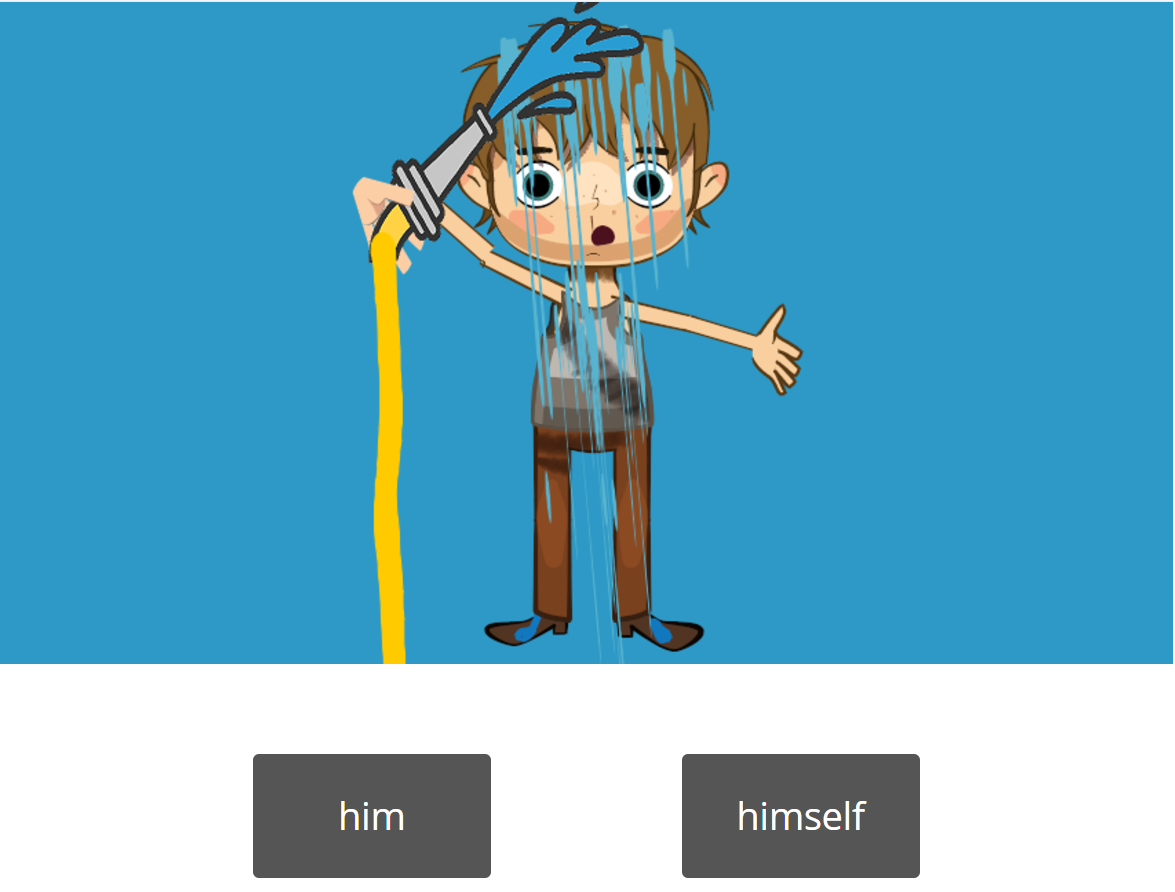
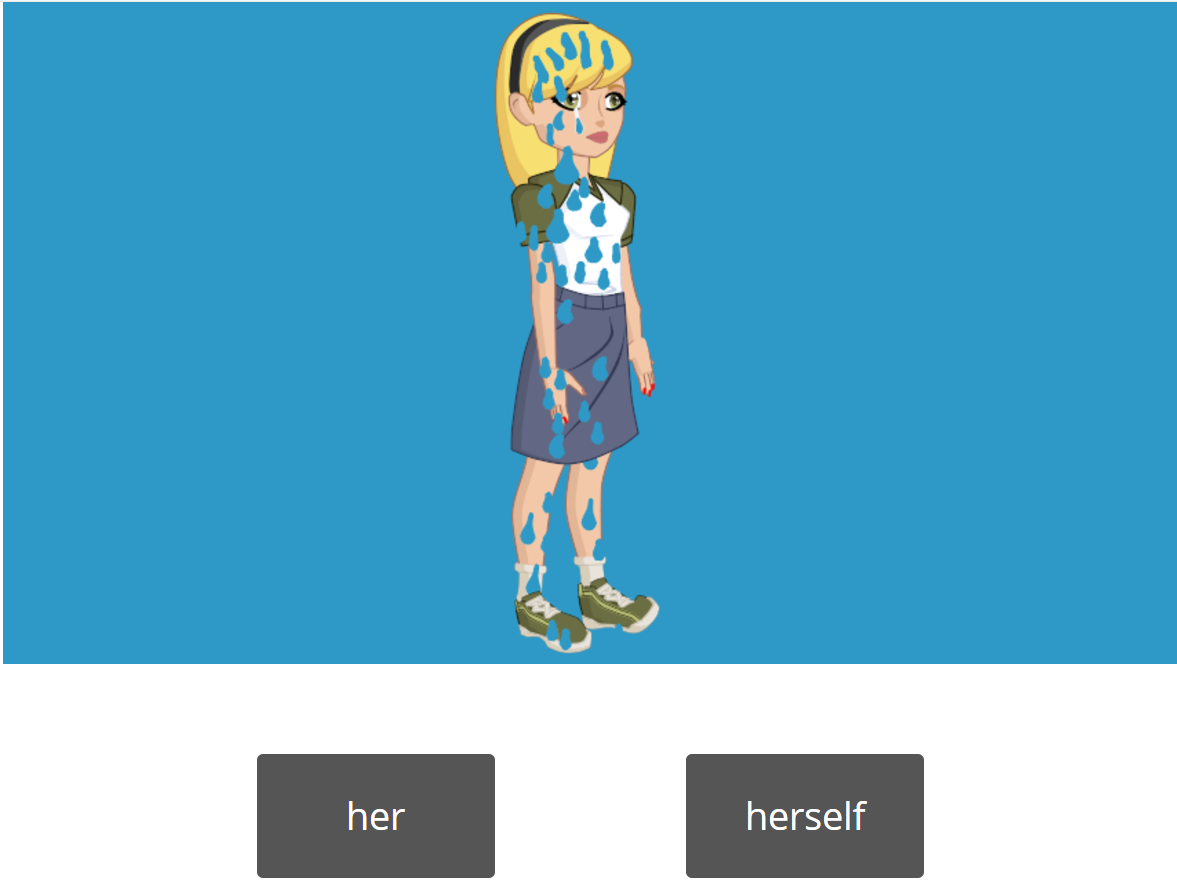
The experiment used a simple one-way within-subjects design, with the binary predictor of ‘condition’: agentive (e.g., Samuel sprayed water all over…’) versus stative: Samuel has water all over…). The binary dependent variable was whether the sentence was completed with a (gender-matching) reflexive (himself, herself), or non-reflexive (e.g., him, her) pronoun. Table 1 lists the 16 test sentences that were presented for all participants. Each of the 16 trials presented a unique character via both narration as the grammatical subject and via visualization in a cartoon video (e.g., Samuel in Figure 1; Sophia in Figure 2). Characters were never repeated over items (i.e., we created 16 characters; 8 female) in order to avoid any prior implication that the character was the agent in scenarios where a substance’s ‘stative’ condition was (randomly) presented later than its ‘agentive’ condition. Each trial conveyed that the character was affected by having one of eight possible substances physically all over them (paint, spaghetti, water, sun cream, toothpaste, milk, mud, ketchup). These eight substances (e.g., water) were presented in both an agentive-condition trial and a stative-condition trial. The agentive condition trial used a lexical verb (e.g., Samuel sprayed water…), such that the character was actively responsible for the resulting state of affairs (e.g., Figure 1); but this was not (necessarily) the case for each substance’s stative condition trial, which always used the generic stative verb form has (e.g., Sophia has water…) (e.g., Figure 2)3.
Figure 1. Example agentive condition trial as represented by a freeze-frame following a video animation for a ‘water’ substance (accompanied by the narration: “Look! Samuel sprayed water all over…”) |
Figure 2. Example stative condition trial as represented by a freeze-frame following a video animation for a ‘water’ substance (accompanied by the narration “Look! Sophia has water all over…”). |
| Table 1. Sentence conditions (listing all 8 trials per condition) | ||
|---|---|---|
| Substance | Agentive | Stative |
| Paint | Joshua brushed paint all over… | Anna has paint all over… |
| Spaghetti | Elijah spilled spaghetti all over… | Leah has spaghetti all over… |
| Water | Samuel sprayed water all over… | Sophia has water all over… |
| Sun cream | Noah rubbed sun cream all over… | Mia has sun cream all over… |
| Toothpaste | Emma squirted toothpaste all over… | Leo has toothpaste all over... |
| Milk | Olivia poured milk all over… | Arthur has milk all over… |
| Mud | Katie splashed mud all over… | Alfie has mud all over… |
| Ketchup | Chloe splattered ketchup all over… | Levi has ketchup all over… |
All narrations were recorded by a native British English male speaker. Each trial’s narration was recorded twice: either with a (later spliced out) reflexive or non-reflexive ending – this was in order to control for any unexpected pitch contour cues towards either him or himself. Each participant listened to 50% of items in each spliced version (split equally by agentive and stative condition)4. The video animations were created using Moho Studio Pro 13 (Smith Micro Software, 2022). For example, the water trial in the ‘agentive’ condition (Figure 1), was accompanied by a video showing the process of the character spraying water (agentive properties) and an end state of water being all over that same character (directly affected patient properties); whereas the water trial for the ‘stative’ condition (Figure 2) was accompanied by a video of a character walking into the shot from offscreen (50% from the left side) already in the directly-affected end state of having water all over them. The stative visual could have been represented by a still picture, but it would have introduced a confound to have an animation for the agentive condition alone. All media files are available in the OSF materials, and the experiments are available to run via Gorilla Open Materials https://app.gorilla.sc/openmaterials/1006731 [adults] and https://app.gorilla.sc/openmaterials/1006725 [children].
Procedure
A forced-choice sentence-completion paradigm (with accompanying animations) was administered within one individual session which lasted no longer than 20 minutes. The web-based platform Gorilla.sc (Anwyl-Irvine et al., 2020) was used to program and run the experiment. Each participant took part individually – adults remotely online using their own computers or tablets, and children in a quiet school setting with headphones and the researcher present. Trials were presented in random order. The sequencing within each trial was as follows. First, an image of the substance alone (e.g., ‘water’, regardless of its condition) was shown, along with a neutral narration (e.g., “The next cartoon is about water.”) – this was to make the substance clear to the participant before the crucial test video. Next, the test sentence itself was played alongside its video animation, which lasted no longer than 4 seconds (e.g., Samuel [poured/has] water all over...). The (incomplete) narration was interrupted by either a cough or a sneeze (counterbalanced across participant lists), at which point the video’s final frame was frozen into a still image. At this point, forced-choice response buttons appeared (e.g., him vs himself): adults completed the sentence by clicking a button (resulting in no missing-data trials), whereas children provided their responses verbally, with the researcher then clicking the relevant button (left vs right positions were equally counterbalanced across conditions, and across items via participant lists). If the child did not answer, the experimenter asked “Should it be him or himself [or her or herself]?” until an answer was provided. A practice task (listed in the Appendix: Table A.1) was also provided to familiarize participants with the procedure before the main experiment, without giving clues as to the crucial test conditions of the main experiment. This practice also ensured that children avoided answers like ‘his shoes’ or ‘her hair’ and instead were already only ever providing the two possible answers to a trial (a gender-matched reflexive or non-reflexive) – this was also helped by the animations displaying the substance ALL OVER the character (i.e., face, hair, arms, legs, hands etc.).
Analysis
The analysis strictly followed the preregistered R syntax (https://osf.io/va9zx/). A series of binomial generalized linear mixed effect models were fitted (separately for adults and children) to the data using R version 4.3.2 (R Core Team, 2023) and its lme4 package function glmer (Bates, Maechler & Bolker, 2014). Specifically, these were built to examine the influence of the fixed effect input term ‘condition’ (sum contrast coded: agentive -.5, stative .5) on the log odds of completing a sentence using a non-reflexive (e.g., him; coded ‘1’) rather than a reflexive (e.g., himself; coded ‘0’). Following Barr et al. (2013; also see Matuschek et al., 2017), the first stage of the modelling process incorporated the maximal random effect structure (whilst assuming ‘condition’ as a fixed effect term). The best fit was then determined through backward steps – where each random effect term was removed if a Likelihood Ratio Test (LRT) indicated that its inclusion did not significantly improve model fit at Barr et al.’s (2014) suggested liberal level of p > 0.205, or if its inclusion led to convergence failure6. For both adults and children, the optimal random effect structure included a random intercept only for Participant with by-Participant random slopes for trial number:
glmer(response ~ condition + (trial_number + 1| participant), data= Datafile, family = "binomial" (link = "logit"), glmerControl(optimizer ="bobyqa"))
The significance level was set at p < .05 in all preregistration documents. Full details of the statistical approach, along with all data and analysis scripts can be found in the R scripts titled “MAIN” within the adult and child subfolders of the main OSF link: https://osf.io/va9zx/ ).
Results
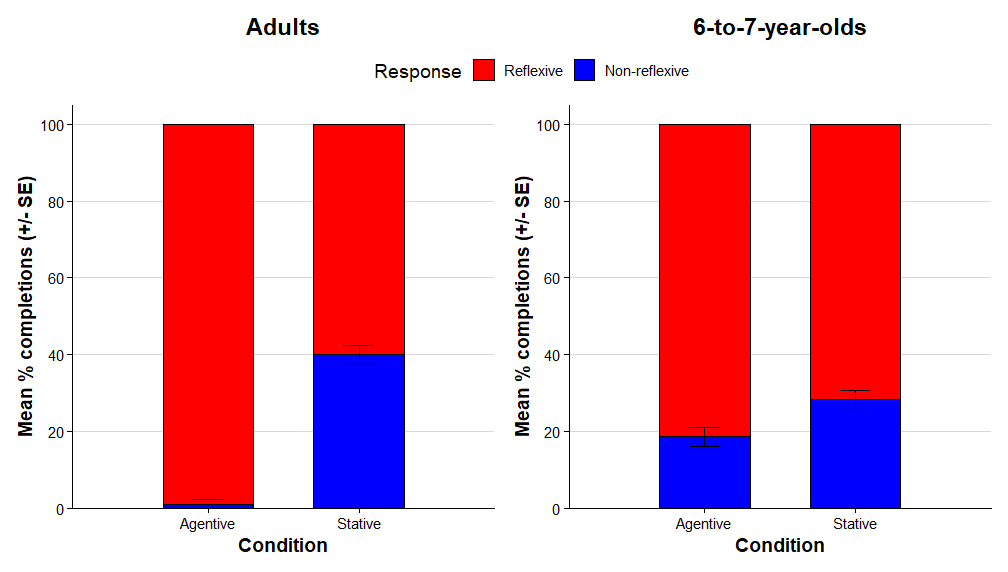
The Figure 3 plots (left panel: adults; right panel: 6- to 7-year-olds) each present the mean percentage of himself/herself (reflexive) vs him/her (nonreflexive) completions for the agentive condition, in which the affected character was clearly also the AGENT (e.g., Samuel sprayed water all over…) versus the stative condition, in which the affected character was NOT necessarily also the agent (e.g., Samuel has water all over…). In line with our preregistered confirmatory prediction, both adults and children were significantly more likely to choose him/her in the stative (e.g., has water) condition (adults: M = 40.02% [SE = 2.29, SD = 49.1]; children: M = 28.3% [SE = 2.50, SD = 44.3]) than in the agentive (e.g., sprayed water) condition (adults: M = 1.04% [SE = 1.36, SD = 10.2; children: M = 18.6% [SE = 2.40, SD = 38.4]), adult odds ratio = 1842.95, SE = 1545.23, p < .01, CI [356.31 – 9532.48]; child odds ratio = 2.31, SE = 0.49, p < .001, CI [1.53 – 3.49]). That is, the stative condition (relative to the agentive baseline) was associated with a significant increase in him/her (nonreflexive) rather than himself/herself (reflexive) completions. This effect was found for both groups, with adults displaying a +39 percentage point shift and children a +10 percentage point shift toward him/her (nonreflexive) responses. Full models, with values for all fixed and random effects, can be found in the Appendix Table A.2.
Note that whilst individual differences were not part of the study and its preregistered plan, follow up descriptives confirmed that the effect was consistent across the majority of participants (i.e., not driven by large condition differences among a small minority): 60/60 adults and 52/60 children produced an equivalent or greater number of non-reflexives for the stative condition than for the agentive condition.
Figure 3. Mean reflexive (red) and non-reflexive (blue) completions in an agentive versus stative condition (Left panel: adults; Right panel: 6- to 7-year-olds). Error bars represent +/- SE of the mean across participants within each condition. Note. The reflexive and non-reflexive response completion percentages are complementary (the stacked bars within each condition level sum to 100%). |
General Discussion
The aim of this study was to investigate how language users determine when to use reflexive (e.g., himself) versus non-reflexive (e.g., him) pronouns. Specifically, our design asked whether pronoun choice can be explained by functionalist-pragmatic cues related to perspective-taking (via our agentivity manipulation). We presented English speaking adults and 6- to 7-year-olds with a sentence-completion task in which they had to choose between a reflexive and non-reflexive to complete a sentence about an unambiguous intended referent (e.g., Samuel) that was directly affected by the event (e.g., 8-9: repeated below).
(8) Samueli sprayed water all over __________.
(9) Samueli has water all over __________.
In our agentive condition (e.g., 8) where the character was also clearly the agent of the action, both adults and children displayed a very strong preference for reflexives. In our stative condition (e.g., 9) where the character was not necessarily the agent of the action, participants selected the non-reflexive form at significantly higher rates (adults: 40%; children: 28%). These findings are compatible with a functionalist-pragmatic account, which frames our manipulation as one of “perspective taking”: himself is used in agentive sentences to highlight the agent’s own perspective over the event, whereas him can be used in the stative condition because it is plausible to take an objective “view from nowhere” (i.e., as a result of Samuel not necessarily being the agent).
Traditionally, reflexive versus non-reflexive pronoun use has been explored for ‘special cases’ like (1-2: repeated below) where himself or him must be used in mutual exclusivity.
(1) Samueli washed himselfi.
(2) Samuelj washed himi.
Our functionalist-pragmatic explanation for why participants always used himself to complete our agentive sentences (e.g., 8) draws upon the same account we have provided for sentence structures like (1): the character who is directly affected is also the one who initiates the action (e.g., Ambridge et al., 2014; Blything et al., 2025; Cole et al., 2015; Harris & Bates, 2002; Kuno, 1987; MacWhinney, 2008, 2009; Matthews et al., 2009; Van Valin & LaPolla, 1997). Crucially, such scenarios always require taking the perspective of the intended referent (Samuel), and therefore the speaker will always use a reflexive pronoun because it functions to mark this (i.e., "I am seeing the event as seen from Samuel’s viewpoint"). This framework extends to explaining why participants were significantly more likely to use him in the (syntactically identical) stative sentences like (9), by drawing upon its explanation for why him always has to be used for sentences like (2): the intended referent is directly affected by the event but is not the initiating agent of the action. Scenarios like (2) and (9) thereby do not require the intended referent’s viewpoint to be taken, affording a “view from nowhere” and licensing the general purpose functioning him. Of course, in the case of our stative condition it is still possible that the intended referent Samuel is the initiating agent. Indeed, even adult speakers used himself rather than him on over 50% of stative trials, presumably because they saw the event from his viewpoint.
Our findings for adults underline the function of reflexives and non-reflexives as discourse tools for encoding how speakers and listeners take perspectives within an event. Whilst an array of prior research has shown that a range of functionalist-pragmatic cues can explain adult pronoun interpretation, most have focused on the interpretation of ambiguous pronouns (e.g., Blything et al., 2025; Kaiser et al., 2009), and/or sentence structures for which pronoun interpretation is not traditionally argued to rely on innate syntactic rules (e.g., Arnold, 2010; Hartshorne, 2014; Kehler et al., 2008; Kehler & Rohde, 2013; McDonald & MacWhinney, 1995; Pyykkönen & Järvikivi, 2010; Schumacher et al., 2017). For example, in the Introduction we cited existing work which has shown that functionalist-pragmatic cues can broadly explain the most likely interpretation of ambiguous object position pronouns in sentences, regardless of whether himself or him is the used form (Blything et al., 2025; Kaiser et al., 2009; Sekerina et al., 2004). In contrast, our work is the first to investigate the role of functionalist-pragmatic cues on the likelihood that speakers choose himself versus him for an unambiguous intended referent.
Crucially, the present study provides the first empirical evidence that English-speaking children’s selection of himself versus him is guided by functional-pragmatic cues like agentivity which influence whether they take perspective of the intended referent or take an objective view. These cues are learnable through probabilistic and contextual regularities, and so can fit a developmental multiple-constraints constructivist framework for the emergence of children’s mastery of cues to pronoun use and interpretation (Allen et al., 2015; Ambridge et al., 2014; Arnold et al., 2007, 2019; Blything et al., 2021; Matthews et al., 2009; Theakston, 2012). Indeed, these present findings align with those of prior work which has reported that children as young as three demonstrate sensitivity to functional-pragmatic cues like agentivity in their interpretation of other pronoun forms in other sentence structures (e.g., subject position pronouns like he, as in Pyykkönen et al., 2010; also see Blything et al., 2021). In fact, the growing evidence from both adults and children that functionalist-pragmatic cues have the potential to provide full coverage of pronoun use and interpretation, is advantageous for the proposed constructivist framework. Specifically, whilst both formalist and functionalist-pragmatic accounts can do an equally good job of explaining the data, only the latter can potentially explain the lion’s share of the phenomena without relying on another account for add-ons. Not only does it make sense that ‘special cases’ of himself versus him (i.e., where one form always has to be used) can draw upon the SAME resources used for when these pronoun forms appear optional and/or ambiguous, but this generalizability would also be advantageous in the sense that language learners need to master these skills in everyday life ANYWAY (e.g., real-world and mental state-reasoning, taking perspectives). As we discuss later, an important disclaimer here is that we are of course not saying that this can explain every case of him versus himself - there may well be other factors too, but this is a starting point for a highly generalisable explanation with potentially wide-ranging coverage (see examples 10-18 below).
An interesting finding from the present study is that – though our preregistration did not provide a statistical comparison between adults and children (since it is not clear that any theory necessarily makes different predictions here) – it was clear that adults showed a larger difference between pronoun choice (e.g., him vs himself) in the agentive versus stative conditions than did children. Specifically, children used him (i) more often than adults (18.6% vs. 1%) in the agentive condition7, and (ii) less often in the stative condition (28.3% vs. 40%). Although we cannot rule out the possibility that children simply show higher rates of indiscriminate “guessing”, a more interesting possibility is that 6- to 7-year-olds have not yet fully developed in their ability to integrate and weight the wide-range of functional-pragmatic cues.
In particular, a potentially important set of cues that were not investigated in the present study are those relating to frequency (Hestvik & Philip, 2001; Philip & Coopmans, 1996; Matthews et al., 2009). Whilst the so-called ‘delay for non-reflexives’ in English has been linked to task difficulties (see Introduction), a constructivist account predicts that difficulty should ease in a graded fashion according to exposure to abstract regularities in the language input. Gradual mastery under this account means frequency effects should be conceptualized in terms of abstract features within each construction type, capturing the graded consistency of mappings between form and discourse function (see Abbot-Smith & Behrens, 2006; Ambridge et al., 2015; Blything et al., 2021; Kidd et al., 2007; Messenger et al., 2011; Noble et al., 2015). For example, verbs like dressing or washing are generally considered as inherently reflexive so appear relatively less in non-reflexive constructions. However, they may be more readily interpreted as non-reflexive when used in contexts that reflect their frequency in real-world events (e.g., dressing someone else is a relatively frequent and plausible event when it involves, for example, parents and children; e.g., The daughter said that the mother dressed her). This would fit the recent adult findings by Blything et al. (2025; see Introduction), who constructed a broad set of manipulations in terms of how they reflected real-world plausibilities. They reported that such cues explained the lion’s share of variance in interpretation of himself and him (see Introduction, examples 5-6), and hence proposed that real-world frequency (the meaning most likely intended by the speaker) forms part of a single underlying construct that determines pronoun use and interpretation.
While the present study required tightly controlled stimuli where child-friendly animations were needed to accompany the narrations, it would also be of interest for future adult work to investigate how the likelihood of him versus himself varies across more graded contexts that could be defined by how strongly they invite taking the perspective of the intended referent (i.e., Samuel) relative to a more objective view. For instance, examples (10–18) together go beyond the scope of the design of the present study because they would seem to continuously vary in how much they encourage the listener to view the event from Samuel’s point of view, versus a more objective third person view (or “view from nowhere”) in a way that predicts use of reflexive (himself) versus non-reflexive (him) pronouns for referring to Samuel.
(10) Samueli wanted a picture of himselfi (*himi)
(11) Samueli drew a picture of himselfi (*himi)
(12) Samueli strung a rope around himselfi (>himi)
(13) Samuelipulled the blanket over himselfi (>himi)
(14) Samueli has dirt on himi (himselfi)
(15) Samueli hid the book behind himi(>himselfi)
(16) Samueli heard the story about himi (>himselfi)
(17) Samueli saw a snake near himi (>himselfi)
(18) Samueli ignored the book behind himi (*himself)
Examples (10-11) capture scenarios other than those presented within the tightly controlled scope of the agentivity condition of the present design that can also result in the language user having to always take the intended referent’s perspective and so always require the use of himself. That is, in examples (10-11), the agent Samuel is not a directly affected patient/recipient, yet him cannot be used. Crucially, this aligns to our commentary in the Introduction that the use of himself versus him is not down to a simple semantic rule of agentivity but that, rather, agentivity acts as a probabilistic cue for the core underlying principle of perspective taking. Drawing upon commentaries by MacWhinney (2008, 2009), a promising follow up on our design would be to test the possible importance of shifting from the perspective initially adopted for the event being described. That is, it would seem that the use of him is increased in (10-18) by the extent to which one detaches from the perspective of the initial viewpoint of Samuel. Consider (15): even though the physical distancing event is enough to shift perspective away from Samuel (allowing him), once the act of hiding is completed our perspective can potentially revert back to Samuel affording us to optionally still adopt his viewpoint (allowing himself). It is worth noting that much of this partial maintenance for the initial viewpoint (Samuel) can be attributed to the fact that the hiding act implies it is still on his mind; when this is replaced in (18) with a verb like ignore that implies it was no longer on his mind at all and then the shift is a full detachment and disallows himself.
Moreover, such shifts that result in full (rather than partial) detachment from the initial perspective can be signalled by intervening material like (18) but also classic binding principle scenarios involving clause boundaries. For example, our functionalist-pragmatic account explains that himself cannot mean Oliver in “Oliver said that Samuel washed himself”, because the perspective has fully shifted to Samuel (i.e., referring back to Oliver with himself would require maintaining Oliver's perspective across a clause boundary that has already triggered detachment from it). This can potentially also speak to “island restrictions” raised by binding principles. Specifically, the syntactic explanation that himself cannot be used to refer to Oliver in “Oliver told Samuel to put it near *himself” because himself is not in the same clause as Oliver, converges with a functionalist-pragmatic explanation that it is because the clause boundary triggers a full detachment from Oliver’s viewpoint (if himself functions as a discourse marker of continued perspective, it cannot refer to Oliver because Oliver is no longer an active viewpoint). To be clear, we do not claim that functionalist-pragmatic perspective-taking cues single-handedly explain every distribution of reflexives versus non-reflexives – whilst we have offered some further examples above, there will of course be other sentence types that are both out of scope of the present study’s design and not explored here in the General Discussion.
A reviewer raised several cases that go beyond the scope of our design and are not immediately explained by the current framework. Whilst in principle, we believe that functionalist accounts along the lines of what we have proposed could account for these, they help further motivate future studies to investigate where functionalist-pragmatic cues extend, and where they may not. First, consider the following cases which do not allow him to refer to the subject: [i] hei did it all by himselfi (*him), [ii] hei is unhappy with himselfi (*him), [iii] hei will have to chat with himselfi (*him). Each could be explained alongside (10-11): these are self-directed predicates that afford the initial viewpoint of the intended referent to remain dominant. Second, consider an alternative “dirt” example to (14), where the subject is inanimate and a reflexive is no longer allowed: [iv] iti has dirt on iti (*itself). This can potentially draw on our explanation for (18) which also does not allow himself: if a reflexive is supposed to mark that the speaker is adopting the referent's own viewpoint, this function is simply inapplicable to [iv] because the inanimate referent is incapable of holding a viewpoint. Further, the reviewer considered that reflexives generally have a physical interpretation like [v] Johni put a label on himselfi whereas a non-reflexive can be more readily metaphorical: [vi] Johni put a label on himi. This could mirror our argument that a non-reflexive can be licensed to refer to the subject when there is a more detached (metaphorical rather than physical) interpretation. A final example was [vii] Johni took a wallet with himi (*himself), which resembles our example (18; and some may argue 19 too) where himself should not be used to refer to Samuel. A functionalist-pragmatic account could explain [vii] through the role of the intervening material (e.g., a wallet) serving to shift perspective away to fully detach from the subject, and lead to a more objective “view from nowhere” (MacWhinney, 2008, 2009). In fact, consider a more definite expression in [viii] Johni took the wallet with himi (/himself). It could be argued that ‘the wallet’ implies more givenness than ‘a wallet’, allowing more perspective continuity and thus making himself more acceptable (see Blything et al., 2025). We acknowledge that these examples are beyond the scope of the present study’s design and that other factors can operate alongside the functionalist-pragmatic cues we investigate.
In turn, future work such as that proposed above could further situate the findings of the present study within a wider cognitive framework that seeks to explain how a language user builds a mental model of the discourse by framing and tracking entities from a certain viewpoint (Johnson-Laird, 1983; MacWhinney, 1987, 2008, 2009; van Dijk & Kintsch, 1983; Zwaan & Radvansky, 1998). Of course, it is essential to reiterate that the design of the present study only afforded a test of the functionalist-pragmatic framework under the umbrella of a simple semantic role manipulation for which the literature reliably argues can provides probabilistic cues for the more fine-grained underlying principle of perspective-taking. This was discussed in more detail above in order to demonstrate its potential in explaining broader scenarios. As clarified throughout the Introduction, our design investigated this whilst setting aside formalist accounts (i.e., holding syntactic information constant). We nevertheless acknowledge formalist modifications of Principles A and B (Adger & Svenonius, 2015; Chien & Wexler, 1990; Chomsky, 1986; Crain et al., 2017; Reinhart, 1983; Reinhart & Reuland, 1993; Reuland, 2011) and that it remains possible that there are cases of pronoun interpretation that cannot be explained by functional-pragmatic factors, leaving syntactic binding principles to ride to the rescue. In the spirit of the earlier discussed Blything et al. (2025) when they provided functionalist-pragmatic explanations of sentences typically explained by principles A, B, and C, we invite colleagues who believe that they have a phenomenon that constitutes a genuine counterexample to get in touch and arrange an “adversarial collaboration”.
In summary, the present study is the first to offer empirical evidence that the choice to use himself or him in English by both adults and 6- to 7-yearolds can be attributed to functional-pragmatic factors such as agentivity-driven perspective-taking. Reflexive pronouns (e.g., himself) function to signal the speaker’s need to highlight the intended referent’s own perspective on the event, which is especially likely in contexts where the referent is both the agent and the patient of the action (e.g., Samuel sprayed water all over himself). Participants chose a significantly greater proportion of non-reflexive pronouns (e.g., him) in sentences like Samuel has water all over him because it is plausible to take an objective “view from nowhere”, which can arise from manipulations such as reduced agentivity (i.e., as a result of Samuel not necessarily being the agent). Crucially, 6- to 7-year-olds’ use of (non-) reflexives showed sensitivity to these agentivity-driven perspective cues, but this appeared less differentiated than in adults, suggesting that pronoun use and understanding is shaped by learnable, discourse-based cues.
References
Abbot-Smith, K., & Behrens, H. (2006). How do known constructions influence the acquisition of other constructions? The German passive and future constructions. Cognitive Science, 30, 995–1026. doi:10.1207/s15516709cog0000_61
Adger, D., & Svenonius, P. (2015). Linguistic explanation and domain specialization: A case study in bound variable anaphora. Frontiers in Psychology, 6, Article 1421. https://doi.org/10.3389/fpsyg.2015.01421
Allen, S. E. M., Hughes, M., & Skarabela, B. (2015). The role of cognitive accessibility in children's referential choice. In L. Serratrice & S. E. M. Allen (Eds.), The acquisition of reference (pp. 1–24). John Benjamins.
Ambridge, B., Kidd, E., Rowland, C. F., & Theakston, A. L. (2015). The ubiquity of frequency effects in first language acquisition. Journal of Child Language, 42(2), 239–273. https://doi.org/10.1017/S030500091400049X
Ambridge, B., Pine, J. M., & Lieven, E. V. M. (2014). Child language acquisition: Why universal grammar doesn’t help. Language, 90(3), e53–e90. https://doi.org/10.1353/lan.2014.0051
Ambridge, B., & Lieven, E. V. M. (2011). Child language acquisition: Contrasting theoretical approaches. Cambridge University Press.
Anwyl-Irvine, A. L., Massonnié, J., Flitton, A., Kirkham, N., & Evershed, J. K. (2020). Gorilla in our midst: An online behavioral experiment builder. Behavior Research Methods, 52(1), 388-407. https://doi.org/10.3758/s13428-019-01237-x
Arnold, J. E. (2010). How speakers refer: The role of accessibility. Language and Linguistics Compass, 4(4), 187-203. https://doi.org/10.1111/j.1749-818X.2010.00193.x
Arnold, J. E., Brown-Schmidt, S., & Trueswell, J. (2007). Children’s use of gender and order-of-mention during pronoun comprehension. Language and Cognitive Processes, 22, 527–565. https://doi.org/10.1080/01690960600845950
Arnold, J. E., Castro-Schilo, L., Zerkle, S., & Rao, L. (2019). Print exposure predicts pronoun comprehension strategies in children. Journal of Child Language, 46, 863–893. https://doi.org/10.1017/S0305000919000102
Barr, D. J., Levy, R., Scheepers, C., & Tily, H. J. (2013). Random effects structure for confirmatory hypothesis testing: Keep it maximal. Journal of Memory and Language, 68(3), 255–278. https://doi.org/10.1016/j.jml.2012.11.001
Bates, D. M., Maechler, M., & Bolker, B. (2014). lme4: Linear mixed-effects models using S4 classes (R package version 0.999999–0). Retrieved July 28, 2023, from http://CRAN.R-project.org/package=lme4
Bergmann, C., Paulus, M., & Fikkert, P. (2012). Preschoolers’ comprehension of pronouns and reflexives: The impact of the task. Journal of Child Language, 39(4), 777–803. https://doi.org/10.1017/S0305000911000298
Blything, L., Theakston, A., Brandt, S., & Ambridge, B. (2025). Easy as ABC. Functional-pragmatic factors explain “binding-principle” constraints on pronoun interpretation: Evidence from nine preregistered rating studies. Cognitive Psychology, 158, Article 101733. https://doi.org/10.1016/j.cogpsych.2025.101733
Blything, L. P., Irola-Azpirox, M., Allen, S., Hert, R., & Järvikivi, J. (2021). The influence of prominence cues in 7- to 10-year-olds’ pronoun resolution: Disentangling order of mention, grammatical role, and semantic role. Journal of Child Language, 49(5), 930–958. https://doi.org/10.1017/S0305000921000349
Brooks, P. J., & Kempe, V. (2012). Language development (1st ed.). Wiley-Blackwell.
Cantrall, W. R. (1974). Viewpoint, reflexives, and the nature of noun phrases. Mouton.
Chien, Y.-C., & Wexler, K. (1990). Children’s knowledge of locality conditions in binding as evidence for the modularity of syntax and pragmatics. Language Acquisition, 1, 225–295.
Chomsky, N. (1981). Lectures on government and binding. Foris.
Chomsky, N. (1986). Barriers. MIT Press.
Clackson, K., Felser, C., & Clahsen, H. (2011). Children’s processing of reflexives and pronouns in English: Evidence from eye-movements during listening. Journal of Memory and Language, 65(2), 128–144. https://doi.org/10.1016/j.jml.2011.04.007
Cole, P., Hermon, G., & Yanti. (2015). Grammar of binding in the languages of the world: Innate or learned? Cognition, 141, 138–160. https://doi.org/10.1016/j.cognition.2015.04.005.
Crain, S., Koring, L., & Thornton, R. (2017). Language acquisition from a biolinguistic perspective. Neuroscience & Biobehavioral Reviews, 81(Part B), 120–149. https://doi.org/10.1016/j.neubiorev.2016.09.004
Dowty, D. (1991). Thematic proto-roles and argument selection. Language, 67, 547–619. https://doi.org/10.2307/415037
Gelman, A. (2008). Scaling regression inputs by dividing by two standard deviations. Statistics in Medicine, 27(15), 2865-2873. https://doi.org/10.1002/sim.3107
Guasti, M. T., & Chierchia, G. (1999/2000). Reconstruction in child grammar. Language Acquisition, 8, 129–170.
Harris, C. L., & Bates, E. A. (2002). Clausal backgrounding and pronominal reference: A functionalist approach to c-command. Language and Cognitive Processes, 17(3), 237–269. https://doi.org/10.1080/01690960143000227
Hartshorne, J. K. (2014). What is implicit causality? Language, Cognition and Neuroscience, 29, 804–824. https://doi.org/10.1080/01690965.2013.796396
Hestvik, A., & Philip, W. (2001). Binding and coreference in Norwegian child language. Language Acquisition, 8(3), 171–235. https://doi.org/10.1207/S15327817LA0803_1
Kehler, A., & Rohde, H. (2013). A probabilistic reconciliation of coherence-driven and centering-driven theories of pronoun interpretation. Theoretical Linguistics, 39(1–2), 1–37. https://doi.org/10.1515/tl-2013-0001
Jackendoff, R. (1992). Mme. Tussaud meets the binding theory. Natural Language & Linguistic Theory, 10(1), 1–31. https://doi.org/10.1007/BF00135357
Jaeger, T. F. (2004). Binding in picture NPs revisited: Evidence for a semantic principle of extended argument-hood. In M. Butt & T. H. King (Eds.), Proceedings of the LFG04 Conference (pp. 268-288). CSLI Publications. https://typo.uni-konstanz.de/lfg-proceedings/LFGprocCSLI/LFG2004/pdfs/lfg04jaeger.pdf
Johnson-Laird, P. N. (1983). Mental models: Towards a cognitive science of language, inference, and consciousness. Harvard University Press.
Kaiser, E., Runner, J. T., Sussman, R. S., & Tanenhaus, M. K. (2009). Structural and semantic constraints on the resolution of pronouns and reflexives. Cognition, 112, 55–80. https://doi.org/10.1016/j.cognition.2009.03.010
Kehler, A., Kertz, L., Rohde, H., & Elman, J. L. (2008). Coherence and coreference revisited. Journal of Semantics, 25(1), 1-44. https://doi.org/10.1093/jos/ffm018
Keller, F., & Asudeh, A. (2001). Constraints on linguistic coreference: Structural vs. pragmatic factors. In J. D. Moore & K. Stenning (Eds.), Proceedings of the 23rd Annual Conference of the Cognitive Science Society (pp. 483-488). Lawrence Erlbaum Associates.
Kidd, E., Brandt, S., Lieven, E., & Tomasello, M. (2007). Object relatives made easy: A cross-linguistic comparison of the constraints influencing young children’s processing of relative clauses. Language and Cognitive Processes, 22, 860–897. https://doi.org/10.1080/01690960601155284
Kuno, S. (1987). Functional syntax: Anaphora, discourse, and empathy. University of Chicago Press.
Kuijper, S. J. M., Hartman, C. A., & Hendriks, P. (2021). Children’s pronoun interpretation problems are related to theory of mind and inhibition, but not working memory. Frontiers in Psychology, 12, Article 610401. https://doi.org/10.3389/fpsyg.2021.610401
Levinson, S. C. (1987). Pragmatics and the grammar of anaphora. Journal of Linguistics, 23, 379–434. https://doi.org/10.1017/S0022226700011324
Lyu, J., & Kaiser, E. (2024). Logophoricity and the processing of Chinese reflexives. Journal of East Asian Linguistics, 33, 559–597. https://doi.org/10.1007/s10831-024-09287-9
Matuschek, H., Kliegl, R., Vasishth, S., Baayen, H., & Bates, D. (2017). Balancing Type I error and power in linear mixed models. Journal of Memory and Language, 94, 305–315. https://doi.org/10.1016/j.jml.2017.01.001
McDonald, J. L., & MacWhinney, B. (1995). The time course of anaphor resolution: Effects of implicit verb causality and gender. Journal of Memory and Language, 34(4), 543-566. https://doi.org/10.1006/jmla.1995.1025
MacWhinney, B. (1987). The competition model. In B. MacWhinney (Ed.), Mechanisms of language acquisition (pp. 249–308). Lawrence Erlbaum Associates.
MacWhinney, B. (2000). The CHILDES Project: Tools for analyzing talk: The database (3rd ed.). Lawrence Erlbaum Associates.
MacWhinney, B. (2008). How mental models encode embodied linguistic perspectives. In R. L. Klatzky, B. MacWhinney, & M. Behrman (Eds.), Embodiment, ego-space, and action (pp. 369–409). Psychology Press.
MacWhinney, B. (2009). The emergence of grammar from perspective. In D. Pecher & R. A. Zwaan (Eds.), Grounding cognition: The role of perception and action in memory, language, and thinking (pp. 198–223). Cambridge University Press.
Matthews, D., Lieven, E., Theakston, A., & Tomasello, M. (2009). Pronoun co-referencing errors: Challenges for generativist and usage-based accounts. Cognitive Linguistics, 20(3), 599–626. https://doi.org/10.1515/COGL.2009.026
Messenger, K., Branigan, H. P., & McLean, J. F. (2011). Evidence for (shared) abstract structure underlying children’s short and full passives. Cognition, 121(2), 268–274. https://doi.org/10.1016/j.cognition.2011.07.003
McKee, C., Nicol, J., & McDaniel, D. (1993). Children’s application of binding during sentence processing. Language and Cognitive Processes, 8, 265–290. https://doi.org/10.1080/01690969308406956
Noble, C., Iqbal, F., Lieven, E., & Theakston, A. (2015). Converging and competing cues in the acquisition of syntactic structures: The conjoined agent intransitive. Journal of Child Language, 43, 811–842. https://doi.org/10.1017/S0305000915000288
Pollard, C., & Sag, I. A. (1992). Anaphors in English and the scope of binding theory. Linguistic Inquiry, 23(2), 261-303. http://lingo.stanford.edu/sag/papers/LI-binding.pdf
Philip, W., & Coopmans, P. (1996). The role of referentiality in the acquisition of pronominal anaphora. North East Linguistics Society, 26, Article 18.
Pyykkönen, P., & Järvikivi, J. (2010). Activation and persistence of implicit causality information in spoken language comprehension. Experimental Psychology, 57, 5–16. https://doi.org/10.1027/1618-3169/a000002
Pyykkönen, P., Matthews, D., & Järvikivi, J. (2010). Three-year-olds are sensitive to semantic prominence during online language comprehension: A visual world study of pronoun resolution. Language and Cognitive Processes, 25(1), 115–129. https://doi.org/10.1080/01690960902944014
R Core Team. (2023). R: A language and environment for statistical computing (Version 4.3.1) [Computer software]. R Foundation for Statistical Computing. https://www.R-project.org/
Reinhart, T. (1983). Anaphora and semantic interpretation. Croom Helm.
Reinhart, T., & Reuland, E. (1993). Reflexivity. Linguistic Inquiry, 24(4), 657–720.
Rowland, C. F., Westermann, G., Theakston, A. L., Pine, J. M., Monaghan, P., & Lieven, E. V. M. (2025). Constructing language: A framework for explaining acquisition. Trends in Cognitive Sciences, 30(1), 26-39. https://doi.org/10.1016/j.tics.2025.05.015
Reuland, E. (2011). Anaphora and language design. MIT Press.
Runner, J. T., Sussman, R. S., & Tanenhaus, M. K. (2002). Logophors in possessed picture noun phrases. In L. Mikkelsen & C. Potts (Eds.), Proceedings of the 21st West Coast Conference on Formal Linguistics (pp. 401-414). Cascadilla Press.
Schumacher, P., Roberts, L., & Järvikivi, J. (2017). Agentivity drives real-time pronoun resolution: Evidence from German er and der. Lingua, 185, 25–41. https://doi.org/10.1016/j.lingua.2016.07.004
Sekerina, I. A., Stromswold, K., & Hestvik, A. (2004). How do adults and children process referentially ambiguous pronouns? Journal of Child Language, 31(1), 123–152. https://doi.org/10.1017/S0305000903005890
Smith Micro Software. (2022). Moho Studio Pro (Version 13) [Computer software]. https://moho.lostmarble.com
Spenader, J., Smits, E.-J., & Hendriks, P. (2009). Coherent discourse solves the pronoun interpretation problem. Journal of Child Language, 36(1), 23–52. https://doi.org/10.1017/S0305000908008854
Theakston, A. (2012). “The spotty cow tickled the pig with a curly tail”: How do sentence position, preferred argument structure, and referential complexity affect children’s and adults’ choice of referring expression? Applied Psycholinguistics, 33, 691–724. https://doi.org/10.1017/S0142716411000531
van Dijk, T. A., & Kintsch, W. (1983). Strategies of discourse comprehension. Academic Press.
van Hoek, K. (1995). Anaphora and conceptual structure. University of Chicago Press.
Van Valin, R. D., Jr., & LaPolla, R. J. (1997). Syntax: Structure, meaning, and function. Cambridge University Press.
Zwaan, R. A., & Radvansky, G. A. (1998). Situation models in language comprehension and memory. Psychological Bulletin, 123, 162–185. https://doi.org/10.1037/0033-2909.123.2.162
Data, Code and Materials Availability Statement
All data, analysis code and materials for this study are openly available on the Open Science Framework (https://osf.io/va9zx/): the raw data, the R scripts for all preprocessing and analyses (the scripts titled “MAIN” within the adult and child subfolders), and all media files. The experiments can be run via Gorilla Open Materials (adults: https://app.gorilla.sc/openmaterials/1006731; children: https://app.gorilla.sc/openmaterials/1006725).
The studies were preregistered on the website of the Open Science Framework (see https://osf.io/va9zx/). The preregistration consists of both a general description of the statistical analyses used to test our hypothesis, and commented R syntax that had been tested on the pilot data for a priori power calculations (see Participants section). This preregistered syntax was then used to run the final statistical analysis, for which the data and full analysis code are available via the OSF link.
Ethics Statement
All studies were approved by the University of Liverpool Research Ethics Committee (IDs: 11643 (children) and 10230 (adults)). All adult participants provided informed consent for their participation. Child participants gave their assent prior to testing, with prior informed consent given by a parent or legal guardian.
Authorship and Contributorship Statement
Liam Blything: Writing – review & editing, Writing – original draft, Visualization, Software, Resources, Project administration, Methodology, Investigation, Formal analysis, Data curation, Conceptualization. Anna Theakston: Writing – review & editing, Validation, Supervision, Project administration, Methodology, Investigation, Funding acquisition, Conceptualization. Silke Brandt: Writing – review & editing, Project administration, Methodology, Investigation, Funding acquisition, Conceptualization. Ben Ambridge: Writing – review & editing, Writing – original draft, Resources, Project administration, Methodology, Investigation, Funding acquisition, Formal analysis, Conceptualization. All authors approved the final version of the manuscript and agree to be accountable for all aspects of the work in ensuring that questions related to the accuracy or integrity of any part of the work are appropriately investigated and resolved.
Acknowledgements
This work was supported by the International Centre for Language and Communica-tive Development (LuCiD). The support of the Economic and Social Research Coun-cil [ES/S007113/1] is gratefully acknowledged.
Appendix A
| Table A.1. Practice block: trials (for adults, trials 5-8 were moved to the experiment block as verification trials). | |
|---|---|
| Practice trial | Correct Answer |
| The girl washed… | him |
| The boy dried… | himself |
| The boy dressed… | her |
| The girl scratched… | herself |
| The boy washed… | her |
| The girl dried… | herself |
| The girl dressed… | him |
| The boy scratched… | himself |
Note. 1. All practice trials aligned to the agentive (baseline) condition of the experiment block in terms of ensuring that the agent of the action was explicitly clear both in the narration and animation, thereby giving no clues for the crucial ‘stative’ condition of the experiment block (whilst still training participants that the task was always to complete the sentence with either a reflexive or non-reflexive). For example, the non-reflexive practice trial The girl washed… (him) was paired with a bathtub animation of a girl moving a sponge around a boy’s body; and the reflexive practice trial The boy dried…(himself) was accompanied by an animation of a solo boy moving a towel around his own body.
Table A.2. Summary of Generalized Linear Mixed Effects Models (left panel: adults; right panel: 6- to 7-year-olds) for non-reflexive completions in agentive vs stative conditions.
| Adults | 6- to 7-year-olds | |||||||||
| Predictors | Odds Ratios | SE | Statistic | p | CI (95%) | Odds Ratios | SE | Statistic | p | CI (95%) |
| Intercept | 0.00 | 0.00 | −6.94 | <0.01 | 0.00 – 0.02 | 0.10 | 0.03 | −6.69 | <0.01 | 0.05 – 0.20 |
| condition (agentivity as baseline) | 1842.95 | 1545.23 | 8.97 | <0.01 | 356.31 – 9532.48 | 2.31 | 0.49 | 3.96 | <0.01 | 1.53 – 3.49 |
| Random Effects | ||||||||||
| σ² |
|
|
||||||||
| τ00 |
|
|
||||||||
| τ11 |
|
|
||||||||
| ρ01 |
|
|
||||||||
| ICC |
|
|
||||||||
| N |
|
|
||||||||
| Observations | 960 | 960 | ||||||||
Marginal R² / Conditional R² |
0.436 / 0.899 | 0.022 / 0.593 |
License
Language Development Research (ISSN 2771-7976) is published by TalkBank and the Carnegie Mellon University Library Publishing Service. Copyright © 2026 The Author(s). This work is distributed under the terms of the Creative Commons Attribution-Noncommercial 4.0 International license (https://creativecommons.org/licenses/by-nc/4.0/), which permits any use, reproduction and distribution of the work for noncommercial purposes without further permission provided the original work is attributed as specified under the terms available via the above link to the Creative Commons website.
In all our examples, the intended co-referent is indicated by the matching symbol: i. Referential expressions that are not intended to co-refer with the pronoun are indicated by j. In some cases, the written pronoun form is ungrammatical for referring to the intended referent, which we indicate using the symbol: *.↩︎
More formally all relevant principles conceptualize their predictions by referring to a drawing of how the structural relations of grammar would appear on something called a phrase-marker tree. Each element in the tree (e.g., a noun phrase) is said to “c-command” anything of equivalent stature or below. Crucially, reflexive pronouns must be bound by a c-commanding antecedent within a local governing category (within the clause in Samuel washed himself. In contrast, the pronoun him is also bound by a c-commanding antecedent, but this cannot be across a clause boundary (outside of the clause it is in for: Samuel washed him). Chomsky (1981, p. 188) formulates these rules as follows:
An anaphor [i.e., a reflexive pronoun; e.g., himself] is bound in its governing category [here, the governing category is the sentence; thus the reflexive pronoun is bound by – i.e., gets its meaning from – the sentence SUBJECT; here, Samuel].
A pronominal [i.e., a nonreflexive pronoun; e.g. him] is free in its governing category [again, the governing category is the sentence; thus the nonreflexive pronoun is NOT bound by – i.e., does NOT get its meaning from – the sentence SUBJECT; here Samuel].
An R-expression [i.e., a word that refers to something in the world, like Samuel, or the man] is free [meaning that it is NOT bound by – i.e., does not get its meaning from – the sentence SUBJECT].↩︎
For stative sentences we considered using “has got” (e.g., "Sophia has got paint all over ______"), but ruled it out because got can be interpreted as an explicit indication of agentivity. For agentive sentences, we considered using “got” as the verb for all eight substances (e.g., “Sophia got paint all over _____), but instead used main lexical verbs that corresponded to a substance (e.g., brushed paint) so that agentivity was as clear as possible. The main lexical verbs were age-appropriate and selected on the criteria that they were agentive and can be clearly animated.↩︎
The assignment of a trial (N = 16) to either of the spliced versions was counterbalanced across participant lists. For children, the mean difference between agentive vs stative conditions was identical within each splicing condition; similarly for adults, the mean difference between agentivity conditions was close to identical within splicing conditions: 40.38% when a non-reflexive was spliced out, and 37.93% when a reflexive was spliced out.↩︎
LRTs on the inclusion of random intercept terms tested whether there was a need to control for random effects driven by specific (i) subjects and/or (ii) items. In addition, LRTs were run for the nesting within each intercept of the binomial control variable ‘spliced pronoun’ (reflexive -.5, non-reflexive .5) - this tested whether significant random variance was caused by some subjects and/or items displaying different completion preferences for reflexives vs non-reflexives within a certain spliced pronoun condition. Further, LRTs on a random slope term for ‘condition’ were run for each intercept, examining whether control was needed for the possibility that the predicted effect of condition (within both ‘spliced pronoun’ levels) was significantly driven by certain subjects and/or items. Lastly, once the optimal random effect structure was selected, a continuous (centred and scaled; see Gelman, 2008) control predictor “trial number” (continuous) was also tested as a random slope to the intercept that explained most variance.↩︎
Note that the significant findings of the ‘condition’ fixed effect persist for both adults and children even under models that would have had the optimal random effect structure (as tested by LRTs) had their convergence issues been waived.↩︎
A reviewer pointed out that our stimuli decision to use multiple verbs for the agentive condition and repeat a single verb (‘has’) for the stative condition (described in footnote 3) may have contributed to increasing variation in the children’s agentive condition responses. For example, some verbs may have occurred more often with reflexive pronouns in prior experience, and also have nuanced semantic differences (e.g., ‘spilled’ is accidental and non-volitional whereas ‘poured’ is intentional and volitional). However, by-verb descriptive statistics of child responses indicate that they did not appear to follow such a pattern and each was associated with a very strong preference for reflexives, ranging from M = 75.00 to 91.67: rubbed suncream (M = 75.00, SE = 4.97), squirted toothpaste (M = 75.00, SE = 4.24), splashed mud (M = 78.33, SE = 4.34), spilled spaghetti (M = 81.67, SE = 4.59), sprayed water (M = 83.33, SE = 4.32), brushed paint (M = 83.33, SE = 3.60), poured milk (M = 88.33, SE = 3.55), splattered ketchup (M = 91.67, SE = 3.40). Whilst frequency and semantics within our agentive verbs was not a manipulation in the present study, the General Discussion proposes their importance for future tests of the wider explanatory coverage of our functionalist-pragmatic framework.↩︎