
Introduction
Developmental dyslexia (DD) is a condition characterised by slow and inaccurate reading. In particular, it is related with poor decoding skills (reading by using letter-sound correspondences instead of whole word recognition). DD has been associated with deficits in the spoken language system (Snowling, 2000), particularly with phonological deficits in three areas: phonological awareness, short term memory and rapid naming (Wagner & Torgesen, 1987; Bus & Van IJzendoorn, 1999; Snowling, 1998). However, it remains under dispute whether phonological deficits cause some, all or any of the observed reading difficulties and if they do, what the mechanisms involved are.
We will discuss the phonological deficits occurring in DD in a psycholinguistic framework by applying well known and extensively tested model(s) of speech production (Levelt et al., 1999; Dell, 1986). In contrast to some other psycholinguistic models used in the context of dyslexia, these models of speech production, significantly, discriminate between lexical representations and output representations. Lexical representations are permanent and contain only basic information of word-forms (phonemes and possibly stress) whereas output representations are fully formed phonological entities, words or utterances, complete with all the phonological features that speech contains. These output representations are not stored for long periods of time and, consequently, they are formed anew each time when needed. In these psycholinguistic models, the output representations are formed through a process called phonological encoding, which operates in a close relationship with internal speech monitoring. By applying this framework, we will discuss how the mechanisms related to phonological encoding and internal speech monitoring may cause the observed difficulties in dyslexics’ reading and phonological tasks.
It has been hypothesised that problems in phonological representations cause the reading difficulties in dyslexia (Shankweiler et al., 1979; de Gelder & Vroomen, 1991; Fowler, 1991; Elbro, 1998; Mody et al., 1997; Manis et al., 1997; Swan & Goswami; 1997). Some hypotheses locate the deficit specifically in output representations (Hulme & Snowling, 1991; Ramus, 2001) but these hypotheses have not been confirmed in experimental research. Instead, several experiments have found no clear signs of deficits in dyslexics’ representations by investigating output in word repetition, non-word repetition and sentence production tasks (e.g. Ramus, 2008; Szenkovits et al. 2016). However, we suggest that designing experiments that also consider the role of internal monitoring processes in the formation of output representations might lead to different outcomes.
Internal speech monitoring serves the purpose of regulation and error-correction during the phonological encoding process (Gauvin & Hartsuiker, 2020; Nozari, 2018). In short, internal monitoring uses phonological information in the phonological lexicon to supervise and aid the phonological encoding process (the forming of output representations). Monitoring is targeted not only to the end-products of phonological encoding but also to the process itself (for an overview: Nozari & Novic, 2017). In the experiments targeted to chart deficits in dyslexics’ output representations (Ramus, 2008; Szenkovits et al., 2016), tasks (e.g. word and non-word repetition, sentence production) have allowed for the normal functioning of internal speech monitoring, that is, the full information about the end-product has been available during the process either in the lexicon (words) or in short-term memory (non-words). In contrast, we will suggest that in decoding situations phonological encoding operates pre-lexically. In such situations, as the end-product (e.g. word) only emerges in a piece-by-piece fashion, internal monitoring would have no access to phonological information of the complete end-product in the lexicon or short-term memory and phonological encoding would have to operate with reduced monitoring possibilities. This may cause the formation of output representations to be more prone to difficulties in decoding situations in comparison to (normal) speech production.
We argue that reading and speech production share the fundamental mechanism of building phonological forms: they both rely on phonological encoding. To be more precise, we suggest that during the decoding process output representations are formed before lexical involvement by using smaller phonological components as an input (e.g. individual phonemes, syllables). This is in line with the literature in reading research that indicates that at the very early stages of reading, before lexical involvement, the reading process is sequential, sound based and follows the features of speech (for reviews: Pollatsek, 2015; Leinenger, 2014). However, we suggest that phonological encoding functions differently during speech production and word decoding. During speech production, internal speech monitoring is able to regulate the encoding process by comparing the output to the existing phonological lexicon. In contrast, internal speech monitoring cannot function in a normal manner during decoding as the end-product is not known, which makes the decoding process less regulated. This means that whenever we read a word that we do not recognise (and consequently use decoding), we build larger phonological entities from smaller pieces without the knowledge of the end-product during the process. In this situation, we argue, phonological encoding operates under reduced monitoring possibilities.
The involvement of the speech output system in decoding (and reading) is supported by many research findings. There is evidence that the same serial phonological encoding mechanism is used in naming objects and reading their names (Roelofs, 2004). Dyslexics’ rapid naming is more significantly facilitated by phonological cues in comparison to controls, which suggests that slowness in naming is affected by problems in phonological encoding (Truman & Hennessey, 2006). There is also evidence that the masked onset priming effect, which is closely related to the serial nature of the reading process, actually takes place within the speech output system (Kinoshita, 2000; Kinoshita & Woollams, 2002). Additionally, neuroimaging evidence suggests that brain areas associated with speech production are involved in reading much earlier than would be expected if decoding happened outside speech system (Uno et al., 2025; Cornelissen et al., 2009).
 |
|---|
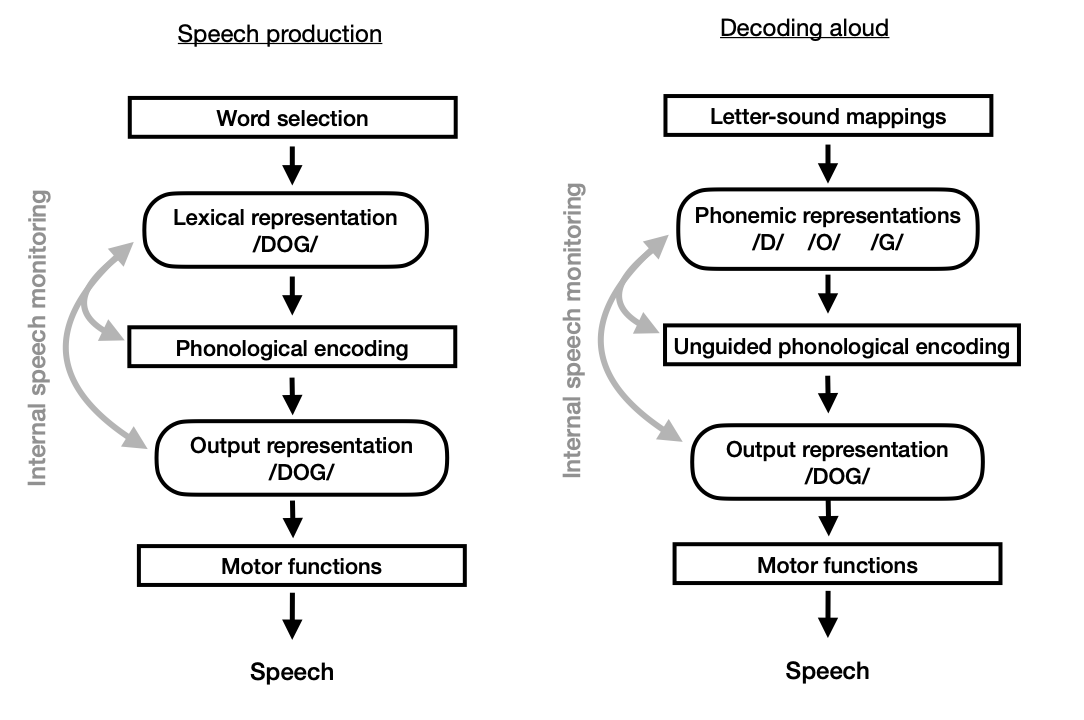
| Figure 1. Simplified models of speech production and decoding aloud. During decoding, internal speech monitoring has no access to full word-form during phonological encoding – a situation here referred to as unguided phonological encoding. Note that the model of decoding aloud is not meant to represent a complete model of word recognition but only to illustrate the interplay between phonological encoding and internal speech monitoring during decoding. |
Thus, to describe phonological encoding in decoding situations, we will extend the notion of phonological encoding into situations where it is done without access to an active word-form either in the lexicon or short-term memory – a process that we call unguided phonological encoding. In speech production, this process is also active, for example, when generating impromptu, continuous nonsense-speech by randomly combining phonemes and/or syllables without preparation. In such a situation, there is no model of the end-product available and the formation of output representations (by phonological encoding) operates in a piece-by-piece fashion. Within the presented framework, our hypothesis can be divided to two parts:
Building phonological word-forms during decoding relies on pre-lexical phonological encoding. That is, decoding utilises unguided phonological encoding (where there is no access to an active word-form either in the lexicon or short-term memory).
DD is related to difficulties in unguided phonological encoding.
It is assumed that beginner-level readers learn to decode through phonological blending (e.g. Rose, 2006). Blending is the process by which smaller phonological components (e.g. phonemes) are built into larger entities (e.g. words) in volitional tasks. We argue that blending and decoding both rely on the same mechanism in building phonological forms: that is, they rely on phonological encoding. The current consensus maintains that dyslexics do not have any specific difficulties in blending but that they demonstrate more general phonological problems (for a review: Melby-Lervåg et al., 2012). Indeed, while dyslexics have considerable decoding difficulties, they seldom fail on generally used blending tasks. We suggest that this discrepancy could be explained by the manner in which the blending process has been defined and measured in earlier research. Typically, blending data in research (and in clinical settings) is collected using blending tasks that contain only simple phonological units in simple phonological environments and where fluency is not measured (for example: combine sounds /c/, /a/, /t/). In our clinical practice, we have developed tasks in which blending needs to be completed in changing and complex phonological environments in a fluent manner, that is, in tasks that resemble reading situations. In these types of tasks, we have observed distinct blending difficulties among children with DD.
Thus, our key argument is that decoding and blending rely on phonological encoding. As phonological encoding is the process where output phonology is assembled (e.g. Keating, 2000), placing phonological blending inside that process could be considered self-evident. However, in research on phonological awareness it is not typically specified where blending takes place or whether it shares any processes with speech production. As for decoding, in many theories of word recognition (e.g. Coltheart et al., 2001; Seidenberg & McClelland, 1989), decoding is assumed to take place outside the speech system. To illustrate our argument, we will offer a brief discussion of the phonological information flow in decoding and in our oral blending tasks.
As mentioned above, dyslexia is related to poor decoding skills (Lyon et al., 2003). In transparent orthographies in particular, this is typically reflected as disfluent decoding (Wagner et al., 2022). This phenomenon fits poorly to the assumption that decoding would take place outside the speech system. If this was the case, the finished word forms would be fed into the speech production chain only when completed and thus one would expect that decoding aloud would consist of periods of silence followed by fluent speech. The silent periods would occur when phonological words were being build outside the speech system, and once the feed (phonological word form) would be sent to the speech system, normal, fluent speech would follow. This is not, however, what one usually observes when decoding is disfluent. Typically, the utterances are slow and sometimes discontinuous; it appears that disfluent decoders are working on the task at the same time as they are producing the answer. To us, this suggests that the feed to the speech production chain does not seem to be whole word-forms, but smaller phonological components that are then combined inside the speech production chain. This argument also applies to the blending tasks that we will discuss. That is, we hypothesise that during blending phonological word forms are build inside the speech output system.
In this article, we have started by outlining the hypothesis that both decoding and blending utilise phonological encoding and that DD is related to difficulties to unguided phonological encoding in specific. We will next proceed to describe our observations of blending difficulties among children with DD. These observations are made in clinical settings, and our aim is not to provide rigorous data but to illustrate our theoretical argument. We will suggest that, first, in contrast with current consensus, there appear to be severe problems in the blending skills of children with DD in a clinical context. Second, we will introduce a set of new types of blending tasks that can be used to measure blending in settings that resemble reading situations. We maintain that the study of blending difficulties among children with DD might offer important knowledge not only about dyslexia but about the functioning of phonological encoding. In the section that follows, we will provide a more detailed discussion of the psycholinguistic model of speech production and unguided phonological encoding. We will then move on to examine a body of earlier research literature on the speech and language difficulties associated with reading problems and discuss how the psycholinguistic model of phonological encoding and speech monitoring could explain the key features of DD. Finally, we will briefly suggest how our hypotheses could be tested. We argue that the focus on the interplay between phonological encoding and internal speech monitoring provides a framework with which we can ask new questions about the phonological difficulties associated with DD.
Blending Difficulties Among Dyslexics
Measuring Blending
In previous research as well as in clinical practice, the principal method for measuring phonological blending abilities has been straightforward: participants are given phonological items, such as phonemes, syllables, or words, and are asked to blend those together. This method is used in many phonological awareness assessment tools such as CTOPP-2 (Wagner et al., 2013) or PAT-2 (Robertson & Salter, 2007), as well as in numerous in-lab assessment packs. While children with DD have shown some difficulties in these types of blending tasks, these difficulties have not stood out from difficulties in other areas of phonological awareness (Melby-Lervåg et al. 2012). This method of measuring blending skills treats blending as an isolated phenomenon, which is most probably intended, but it misses certain features that are essential when blending is used for reading purposes. In the context of reading, blending would be done in constantly changing phonological environments, by combining varying linguistic structures at a very swift pace. In contrast, in typical blending tasks the items are fairly uncomplicated, and the answers are not timed, which means that any difficulties with increasing phonological complexity and/or fluency are not measured.
Interestingly, when children with DD are exposed to more complex blending tasks, rather clear patterns of blending difficulties begin to emerge. This phenomenon is what we have observed in our clinical practice, where we have developed certain types of blending tasks to support the reading skills of Finnish children with DD. Our tasks target a very definite set of skills, namely building a larger phonological structure from smaller items without access to lexical representations and with a limited possibility to use orthographic strategies (including full-word recognition). To ensure that the tasks are completed by relying on phonological blending rather than orthographic or guessing strategies, we use non-words or meaningless syllables as target structures and/or provide the blended items entirely or partly orally. Moreover, by manipulating the pace of the tasks, we make it harder for the children to apply error-correction procedures before giving answers, which makes both blending errors as well as disfluency more readily observable. Finally, in our tasks we use changing phonological environments and vary between tasks where the children are given the task items orally, in writing, or partly orally and partly in writing.
By applying these types of blending tasks, we have observed major difficulties in blending among children with DD – in our case, Finnish children with DD that have fluent grapheme-phoneme associations to all letters of the alphabet and no apparent speech-sound problems. Among the children with DD at our clinic, not only are the blending difficulties common (rather than residual) but they also reflect certain patterns. We have divided the observed difficulties in blending tasks into two groups: errors and laboriousness. Although these groups of difficulties have a resemblance to the types of reading problems associated with DD - that is, accuracy- and rate-related problems (e.g. Lovett, 1984; Wolf & Bowers, 1999) - we have deliberately chosen to use different terminology as the observed phenomenon is not reading but blending.
Blending Errors
Significantly, the blending errors that children with DD make fall into categories that greatly resemble phonological error patterns that occur in the speech of children with phonological disorder (PD) (see e.g. Dodd, 2014), including substitution errors, assimilation, omissions, additions, and metatheses, usually occurring at the level of single phonemes. Speech errors in PD are not necessarily higher in phonotactic probability in comparison to error-free utterances, and this is also the case with blending errors – they are not necessarily higher in phonotactic probability in comparison to error-free blending. The observed error types occur both with vowels and consonants in various phonological contexts. While we have not tried to map out all types of potential errors based on our clinical observations, certain phonological environments, such as consonant clusters and diphthongs, seem to be more prone to errors. As with the errors in PD, it is conceivable that there are certain patterns depending on the phonotactics of the language in question. Our aim here is not to describe a set of typical patterns in Finnish but to present a few observations to illustrate some of the error types that children with DD at our clinic typically demonstrate. Moreover, what we see at the clinic are idiosyncratic patterns of errors that may vary from a general difficulty related to several phonemes to very narrow difficulties with one or two phonemes in specific syllable structures and combinations. The following examples are collected from different children with DD between ages 9-12.
To start with the case of consonant clusters, the errors that emerge often look like this: when a child is asked to blend a written syllable with another syllable given orally, for instance sin and /so/, the produced answer involves consonant errors (e.g. [sinto] instead of sinso). In our tasks, the errors do not necessarily emerge if only two items are blended (e.g. into one syllable/word) but become apparent when the same blending process is repeated in a series of items – which is closer to the process of reading out loud or producing continuous speech. We usually see errors emerging in a task in which the child is asked to continuously blend a list of written syllables with an orally given syllable, for instance, adding /so/ to the end of five different syllables sin, ket, lok, mat, vel, which would correctly result in sinso, ketso, lokso, matso, velso but may, in fact, come out as [sinto kesso kolso matso veltso]. That is, the blending difficulties emerge in the form of several different patterns, including substituting /s/ with /t/ in [sinto]/sinso, an assimilation in [kesso]/ketso, a metathesis in [kolso]/lokso and an addition of a /t/ in [veltso]/velso. It is important to note that the children do not have any trouble reading the first syllables without the orally added second syllable, yet in the blending process errors may also emerge in the orthographically given item. What is more, the same children do not have any difficulties in fluently repeating the blended targets if the full model is given, that is, they do not have any trouble producing the problematic sound combinations in speech (here blending a CVC syllable with a CV syllable beginning with /s/).
Despite the fact that errors are more likely to occur in more complex contexts, it is not uncommon that children with DD also struggle with blending two phonemes into a syllable if they need to do this repeatedly, and this is something that we often see if the child has difficulties with vowels. For example, in a task in which a child is asked to add a certain vowel after a set of written letters, the vowel begins to vary (e.g. written consonants k, l, s, m, p + sound /a/ should result in ka la sa ma pa but becomes [ka, la, si, ma, pe]). Vowel errors also emerge in a task where children need to blend two CV syllables (e.g. written syllables pe so ri ma tu + /ka/ should result in peka, soka, rika, maka, tuka but becomes [pek ka soki riki maki ka tuk ka]). Often there are detectable patterns, such as the strong tendency to substitute /i/ for /a/ in the previous example. Some children have a rather general difficulty here, whereas others are more prone to making vowel errors after certain consonants, and yet others have a greater tendency to make errors with certain vowels regardless of the imminent phonological context. In the previous example, apart from difficulties with vowels, the child also has difficulties with the length of the consonant (in Finnish the length of phonemes is a distinctive feature).
In the examples above, the difficulties have occurred while producing a series of single syllables or short non-words. However, with practice, children with DD often learn to blend items and to read fluently at the level of syllables or short words - that is, in simple phonological contexts. Yet their difficulties remain in more complex or alternating phonological environments. Creating blending tasks involving complex phonological environments that rely solely on orally given items is challenging due to restrictions of working memory. Thus, we often chart blending difficulties emerging in more complex phonological contexts in tasks where children need to blend an increasing number of syllables, most or all of which are given orthographically. Typically, a child may be fluent in reading syllables and blending syllables into short words (e.g. syllables kor and lik into [korlik]) but begins to struggle with longer words, for instance, in blending syllables kor + lik + rap which should result in korlikrap but becomes a series of erroneous attempts: [korliptak … korlitpak]. The child in question has a specific difficulty with voiceless plosives /k/, /p/, /t/, as well as combinations of /l/ and /r/ sounds. Again, we should note that there are no difficulties in repeating the words after a full model. What we also see here are the immediate self-corrections, as the child monitors their attempts, spots the errors and tries to correct them.
Laboriousness of Blending
Among the children with DD at our clinic, an entirely different type of difficulty is the laboriousness of blending. This concerns children for whom the whole process of joining phonological items together is very laborious and slow. Although laboriousness can be observed in various blending contexts, it is often markedly present in complicated and/or rare phonological structures. Yet, as in the previous examples, it may also emerge in very specific contexts, related to specific phonemes, such as adding to /t/ sound to a list of syllables (e.g. pen, kor, ril + /t/ should result in pent, kort, rilt but becomes [pent … kor … ril … t], where the process is not only very arduous but partly erroneous). Again, the child is fully able to read the given syllables fluently without the added sound, and if the child is asked to repeat the target structures, they have no difficulties with the sound combinations. That is, the difficulty is only present in the situation when blending occurs without an activated word model of the end product. As with the blending errors, the laboriousness seems to be a phenomenon that involves variation and idiosyncratic patterns: for some children, it may manifest in all kinds of blending tasks as a general difficulty while for others it only emerges in specific phonological contexts in which blending becomes more arduous.
To sum up, in our clinical practice we have observed major blending difficulties among children with DD in a context where they need to assemble larger phonological units from smaller ones without the possibility to rely (completely) on orthographic strategies or lexical representations. Each child that we have treated in our clinic has had blending difficulties, although the type and severity of these difficulties vary greatly. Some of the children with DD at our clinic mainly demonstrate error-proneness while others mainly struggle with laboriousness. For some children, difficulties only arise in one or two problematic phonological contexts. In contrast to children with very narrow difficulties, children with severe dyslexia typically demonstrate difficulties in a range of phonological contexts and their overall blending processes are characterised by laboriousness. We argue that these difficulties are not residual or random and thus raise significant questions about the role of blending skills in dyslexia.
Our clinical observations suggest a connection between blending skills and reading skills. First, in our tasks, blending difficulties are significantly more pronounced in the performance of children with DD, whereas normal readers learn these tasks quickly and are able to perform them fluently and with no or very few errors. Moreover, the gravity of blending difficulties corresponds closely with the gravity of reading difficulties, and the structures that cause difficulty in blending tasks also cause difficulty in reading. Finally, our clinical experience suggests that improvement in blending skills in our tasks also results in improvement in decoding. It should be noted that blending difficulties occur across different task types, that is, in tasks presented orally, in writing or partly orally and partly in writing. Thus, any mechanisms that cause these difficulties seem to be in operation in each case.
We suggest that these difficulties can be explained by applying psycholinguistic models of speech production (Levelt et al., 1999; Dell, 1986) where blending difficulties would emerge at the level of phonological encoding. This may seem obvious, given that the difficulties that we have observed occur at the level of phonology usually in terms of phonemic errors. Nevertheless, one might ask for further reasoning for locating blending processes in a psycholinguistic speech production model, rather than looking for explanations in other cognitive functions. As regards the types of blending tasks that we use, we argue that the difficulties in blending we have observed are not related to problems in visual processes, speech perception, phonological working memory, or attention control. First, blending difficulties emerge whether or not part of the items is given orthographically; thus, it seems that visual processes are not the root of the problem. Second, difficulties emerge whether or not speech perception was required in the task. Third, when support is provided to working memory and executive function, the problems with blending persist. Moreover, if there were difficulties in short term memory and/or executive function, we would expect random errors in tasks. Instead, what we have observed are regular and consistent difficulties in terms of errors and laboriousness. Thus, we propose that the source of blending difficulties is in the operation of phonological encoding. However, to be able to explain how blending is done without meaningful words as a starting point, the model of speech production also needs to describe speech that is produced without reference to active word-forms. To achieve this, we introduce a component that we call unguided phonological encoding.
Phonological Deficits in a Psycholinguistic Framework
Phonological Encoding and Unguided Phonological Encoding
Detailed descriptions of phonological encoding in the speech production chain can be found in Levelt et al. (1999), Roelofs & Meyer (1998) and Dell (1986). Briefly, in the speech production chain, the process of phonological encoding follows stages where a word form is accessed in the mental lexicon and goes first through morphological encoding. In phonological encoding, this word form is then retrieved piece by piece through two parallel and at least partly independent processes: the retrieval of segmental information (phonemes) and the retrieval of metrical information (number of syllables, stress, etc.). These processes are called segmental spell-out and metrical spell-out. Next, using segment-to-frame association the retrieved segments are combined in a metrical frame. This recombination is made incrementally, from left to right, and it can begin to operate without completed information of the word form, suspending or resuming the recombination process according to the availability of segmental or metrical information. There is some uncertainty about how much metrical information word forms in the mental lexicon contain. According to the most parsimonious view (Levelt et al, 1999), almost all metrical information is created during the encoding process. Whether or not this is true, at least part of metrical information is necessarily created during the phonological encoding process because the syllabification of a phonological word - that is, the end result of the phonological encoding process affected by morphological processes and the phonological environment of the word - does not always follow the syllabification of a lexical word. Additionally, there are processes related to prosody and stress. Once completed, the phonological word is ready for further processes in the speech production chain, including phonetic encoding and articulation. It is important to note that in the phonological encoding process the word form is not retrieved as a whole but it is combined from pieces. It is assumed that this piece-by-piece combination of word forms each time that they are used (spoken) serves the purpose of generating connected speech (Levelt, 1992).
There are several models (e.g. Hanley et al., 2004) that describe how speech can be produced without the involvement of the mental lexicon, which takes place, for example, in auditory repetition of non-words. To our knowledge, however, there has been no discussion of how phonological encoding operates when producing speech without a reference to any activated word form(s). This sort of situation occurs, for example, when generating impromptu utterances of nonsense-speech. The fact that this sort of speech production is possible indicates that the phonological encoding process can operate in a piece-by-piece fashion without a model of the end-product. Moreover, this means that there is a notable amount of flexibility in the processes that take place in phonological encoding.
Blending and decoding, we argue, are other instances where phonological encoding operates without access to a complete word form. Instead, the input consists of small phonological components (e.g. phonemes or syllables) and the knowledge of their order. How would this change the encoding process? The input would be taken into the segmental and metrical spell-out processes. As in the typical encoding process (using the word form from the mental lexicon), also here the phonemes would not necessarily be retrieved at once, but the process would begin with some of the components, and more would be retrieved during the process. Similarly to the typical phonological encoding process, the segment to frame association would be done incrementally, from left to right, and it would be operated without all information being available, suspending or resuming the process according to the availability of segmental or metrical information. In contrast with the typical process, during the segment to frame association there would be less knowledge or no knowledge at all about the metrical frame. The missing metrical information would have to be created during phonological encoding, which might or might not change the process. After combining the segments into a metrical frame, the rest of the processes (creating intonation, stress etc.) would be dependent on the available information. In sum, during an oral blending task or during decoding the phonological encoding process would differ from the typical situation in that there would be 1) less knowledge on the metrical frame and 2) less knowledge about stress. We call this type of process unguided phonological encoding to differentiate it from the way in which phonological encoding operates during typical speech production. We argue that in the unguided process - in which information about the lexical word form is missing - the speech monitoring and error correction processes cannot function in the same manner as they do in typical speech production.
Speech Monitoring
In psycholinguistic models of speech production, phonological encoding functions in close connection with monitoring and error correction processes that take place during speech production (for reviews: Gauvin & Hartsuiker, 2020; Postma, 2000). These processes concern both the form and the content of speech. During speech production, the monitoring processes take place at two different stages: the external loop monitors the output (uttered speech), and the internal loop monitors the production of phonological word forms before initiating the motoric planning of speech production. In the internal loop, monitoring is targeted at the phase where phonological forms are first assembled (e.g. Levelt et al., 1999) and it enables regulation and fast corrections before the motoric planning of speech is carried out (Gauvin & Hartsuiker, 2020; Nozari, 2018). The phonological error correction is found to be among the earliest forms of speech related self-correction (Clark, 1982), observable even before the age of two (Clark, 1982; Forrester, 2008; Laakso, 2006). At the age of three, children already use internal and external speech monitoring flexibly in different situations (Manfra et al, 2016).
It is widely agreed that the external monitoring utilises the speech comprehension system. However, there is some disagreement on the mechanisms of internal monitoring. Some argue that internal monitoring also relies on the speech comprehension system (Levelt, 1993; Roelofs, 2020). According to this view, the phonological word assembled in phonological encoding is sent to a separate monitoring unit (a monitor) that compares this data with the corresponding representations. However, this view conflicts with neuropsychological evidence that suggests a dissociation between the internal monitoring and the monitoring of the speech of others, as well as a double dissociation between comprehension skills and error detection in one’s own speech (see Nozari et al., 2011 for a review of the evidence). According to another view, internal monitoring uses process-related information (Nozari et al., 2011; Nozari, 2020; Gauvin & Hartsuiker; 2020). In this view, internal monitoring focuses on the amount of conflict in phoneme selection. As regards the monitoring of form, this model assumes a layer of lexical nodes and another layer of phoneme nodes with reciprocal connections. A conflict may be detected at the lexical node based on the amount of feedback from the phoneme nodes. A small amount of feedback would signal that the correct phonemes are not activated. This account assumes that internal monitoring is deeply interconnected with the mechanisms of phonological encoding. Indeed, Nozari (2018) has suggested that error detection and correction are only a small part of what internal monitoring does. She proposes that internal monitoring primarily assesses a need for control over the various stages of speech production. If conflict-related activity is increased at any stage, more control is allocated to resolve the possible problem before any errors emerge. Different accounts of internal monitoring are not in conflict with each other. On the contrary, they may complement each other. Recently, Nozari (2024) has proposed a multi-process view of monitoring with several different monitoring mechanisms operating simultaneously.
Importantly, all the discussed mechanisms of internal monitoring are dependent on lexical-level information, that is, on knowledge of the word-form that is being encoded. In unguided phonological encoding – as in oral blending tasks or in impromptu non-sense speech – information about the complete word form is missing, which means that internal monitoring cannot operate in the same manner as in typical speech production. We suggest that this makes the process of unguided phonological encoding more prone to difficulties in comparison with phonological encoding in typical speech production.
Many difficulties in blending and decoding in dyslexia could be explained by errors in phoneme selection and difficulties in finding the correct metrical frame during phonological encoding. In each case, the regulatory support provided by internal monitoring during typical speech production may compensate for the difficulties and problems that become apparent only during unguided encoding. Additionally, it seems that the very process of combining the retrieved segments (e.g. phonemes) may be prone to difficulties (slowness, arduousness) without regulatory support from internal monitoring. This is reflected in the observed slowness in combining even single phonemes (/k/, /a/ -> /ka/) or syllables (/ka/, /to/ -> /kato/) in blending and decoding tasks. Importantly, examination of the differences between phonological encoding and unguided phonological encoding provides a new tool for investigating the mechanisms of creating output representations.
Phonological Encoding and Speech Monitoring in Developmental Dyslexia
There exists a wide range of theoretical proposals about the causes of DD. The phonological deficit theory, discussed in the introduction, remains as the most influential one. Other proposals include problems in rapid temporal processing (Tallal, Miller, & Fitch, 1993), magnocellular abnormalities (Stein & Walsh, 1997), sluggish attentional shifting (Hari & Renvall, 2001), anchoring difficulties (Ahissar, 2007), procedural learning problems (Nicolson & Fawcett, 2007), and a phonological access deficit (Ramus & Szenkovits, 2008). None of these theories or proposals has been able to provide a sufficient account of the phenomena related to DD and currently many scientists have turned their attention to multifactorial explanations of dyslexia (Pennington, 2006; McGrath et al. 2020). Here we will take an alternative route and argue that reading and speech production share certain core mechanisms that can be located in the processes of phonological encoding, and that reading difficulties in DD are a consequence of deficits in these processes.
We hypothesise that DD (in absence of other language difficulties, including PD and developmental language disorder, DLD) results from systematic problems in phonological encoding (related to error-proneness and laboriousness) but with intact internal speech monitoring. During language development speech monitoring has compensated for the encoding problems and, as a result, no major speech difficulties have emerged. For these children, encoding difficulties become apparent only when encoding needs to function without the availability of end-product information (complete word-forms) and thus with reduced monitoring possibilities. That is, when reading practice begins and unguided phonological encoding becomes essential. We suggest that decoding difficulties result from deficits in unguided phonological encoding. We will next discuss how this hypothesis fits with language-related features of dyslexia.
Our theory would predict difficulties among dyslexics in tasks that require a creation of output representations in difficult conditions, that is, that either utilise unguided phonological encoding or utilise typical phonological encoding in such a way that monitoring is not able to compensate for the encoding problems (speeded conditions or complex and novel words/phrases). In previous research, dyslexics have shown difficulties in tasks measuring certain speech abilities, rapid naming, short-term memory, and phonological awareness. We note that the used tasks have required the forming of output representations. To be more specific, they have involved either phonological encoding in difficult conditions or unguided phonological encoding. We argue that the findings in these areas can be explained by our hypothesis.
To start with speech abilities, a consequence of our model is that dyslexics should have speech difficulties in situations where speech monitoring cannot compensate for deficits in encoding. These difficulties could emerge in two forms: error-proneness and slowness (slowness caused by the laboriousness of blending). Indeed, there is a notable amount of evidence of such difficulties: dyslexics make speech production errors and misarticulations in phonologically complex words (Snowling, 1981; Brady et al., 1989). They cannot produce simple or complex phrases as quickly as normal readers, and in complex phrases they make more mistakes (Catts, 1989). They are slow in syllable repetition (Wolff et al., 1990). They have difficulties in sentence repetition (Moll et al., 2015) and in non-word repetition (Kamhi et al., 1988), as well as many sorts of small anomalies in speech (McArthur et al., 2000; Vellutino, 1979). In his discussion of dyslexics' slowness and error-proneness in speech repetition tasks, Catts (1989) concluded that “dyslexics may have difficulties in the planning stage of speech production”. However, to our knowledge, this idea has not been developed further.
Second, a slower performance in rapid naming tasks could also be explained by problems in phonological encoding, laboriousness in particular. There are at least three possible factors causing slow performance. First, laboriousness in phonological encoding can potentially slow down expression of words (as in Catts, 1989). Second, labouriousness in unguided phonological encoding might cause difficulties in producing words very close to each other. Hypothetically, in the case of naming numbers, for instance, a dyslexic might be inclined to keep the phonological entities apart (e.g. /tu:/ /faɪv/ /naɪn/) whereas a non-dyslexic is able to blend them together (e.g. /tu:faɪvnaɪn/), thus speeding up the performance. Third, encoding problems demand an increased use of cognitive resources for speech regulation in speech production, which could slow down the progression in the task. We should note that difficulties resulting from these three factors would be more evident in speeded, serial tasks (in contrast with individual naming tasks) because in these tasks the phonological environment would be more challenging and variating and slowness in speech production would be easier to observe. This, indeed, is a pattern of performance observed in dyslexics (Araújo & Faísca, 2019). It has also been shown that dyslexics' difficulties in rapid automatised naming (RAN) tasks are more pronounced in conventional naming tasks that require the articulation of specific names in comparison to RAN-like categorisation tasks (cancellation or RAN yes/no tasks) (Georgiou et al., 2013). This is in line with our hypothesis.
Third, phonological encoding problems would cause difficulties in many tasks that measure short-term or working memory. As pointed out by Elliot & Grigorenko (2024), to succeed in such tasks one must be able to protect memory representations from interference or decay. As these tasks typically involve spoken responses, any difficulties in phonological encoding would introduce interference compromising the overall performance. For example, in non-word repetition tasks, dyslexics are typically able to repeat short non-words correctly and difficulties only emerge when repeating long non-words (e.g. Marshall & van der Lely, 2009). The interpretation has been that the poor performance results from a narrower short-term memory rather than production problems. However, the interference due to encoding difficulties would provide an alternative explanation of the situation. As we have demonstrated in our examples, those difficulties are often evident in more demanding phonological environments such as long non-words. Apart from interference, phonological encoding problems could also affect performance in memory tasks in another way. In a serial task involving verbal items (e.g. two, five, eight, two, six, eight), intact phonological encoding enables the combination of task items into larger phonological entities in a flexible manner to support memory performance (e.g. /tu:faɪv/, /eɪttu:/, /sɪikseɪt/ or /tu:faɪveɪt/, /tu:sɪkseɪt/). This strategy is weakened if one has unguided phonological encoding problems. Additionally, as with rapid naming tasks, the increased demand of cognitive resources for speech regulation may limit performance in memory tasks.
Finally, there is plenty of evidence that DD is related to difficulties in phonological awareness, even if this does not concern all dyslexics (Saksida et al. 2016; Mundy & Hannant, 2020; Dębska et al. 2022). It has been suggested that all phonological operations that are present in phonological awareness tasks reflect one underlying skill, as the evidence suggests that all phonological tasks applied to material of similar complexity (same linguistic level) are highly interrelated (Wagner et al. 1997; Stahl & Murray, 1994; Stanovich et al, 1984; Schatschneider et al. 1999; Anthony & Lonigan, 2004). However, internal monitoring processes that take place during phonological awareness tasks have not been considered when interpreting the results. We suggest that the constant monitoring and error correction procedures are in use during phonological awareness tasks. This means that while the task itself may require one phonological operation, such as segmenting, internal monitoring enables the use of other operations, such as blending for checking the answer. Further, if any error correction procedures are needed, these may, again, involve further phonological operations, such as phoneme substitution. Thus, there may exist a number of various phonological operations as well as monitoring and correction procedures that are carried out before the answer is given. This might explain the observed interconnectedness of different phonological operations. In any case, the process of unguided phonological encoding (blending) is directly involved in several phonological operations and thus it is very likely that difficulties in phonological encoding would have an effect on performance in phonological awareness tasks.
It is also important to consider the role of phonological encoding in phonological awareness tasks in general. It is probable that all phonological tasks associated with phonological awareness utilise phonological encoding. Let us consider, for example, segmenting: school children, including dyslexics, are taught to segment words by producing the word aloud or silently in one’s mind, making the rhythm of the word more pronounced in the utterance while consciously attending to this process. In terms of the psycholinguistic speech production framework this means that children are instructed to produce an output representation of the word (the process of phonological encoding) while attending to and manipulating this process in a certain way. Assuming a difficulty in the process of phonological encoding would, indeed, predict difficulties also in segmenting (although not as severe, as in segmenting speech monitoring can operate normally as the target word is known). The same argument can be applied to all phonological operations that are related to phonological awareness. The most apparent strategy, and perhaps even the only possible strategy, for performing them is to produce an output representation while attending to and manipulating the process. In sum, we argue that our theory would predict difficulties in all phonological awareness tasks among dyslexics. However, our framework also offers an explanation for why difficulties in phonological awareness have not been found among all dyslexics: when measuring phonological awareness, the fluency (speed) of the process has not been taken into account. If one assumes that the underlying deficit exists in permanent representations, fluency would play no role. However, if the difficulty is in the process of creating output representations, as we argue, measuring fluency would be necessary to chart all aspects of the difficulty.
While difficulties in all the four language-related areas discussed above – certain speech abilities, rapid naming, short-term memory, and phonological awareness – are strongly associated with DD, it is important to note that this is not true of many other phonology-related areas. Dyslexics speak relatively normally, and they show normal or near-normal performance on categorical perception (Hazan et al. 2009), lexical quality recognition (Marshall et al., 2010), prosody (Marshall et al., 2009) and context sensitivity of speech perception (Blomert et al., 2004). The pattern of normal performance in these areas is not sufficiently explained by the phonological theories of DD (for a detailed discussion see Ramus & Ahissar, 2012). However, these varying patterns of performance – difficulties in certain areas and normal performance in others – could be explained by a model where the interplay between phonological encoding and internal monitoring is taken into account.
Testing Our Hypotheses
The first hypothesis in our work is that phonological word-forms during decoding (and blending) are built within the speech output system utilising phonological encoding pre-lexically. We will next discuss the possibilities to test this hypothesis and the evidence from earlier research that there already exists concerning this issue. In our discussion, we also aim to distinguish our hypotheses from other phonological theories of dyslexia.
The role and temporal dynamics of phonological encoding in speech production have been investigated with various methods and there is plenty of knowledge on the subject (for an overview: Kerr et al., 2023). Among the applied methods, we would find dual task set-ups and interference paradigms particularly useful to study the operation of phonological encoding during decoding. For example, we would assume interference in both dual task setups and interference paradigms with silent decoding and speech production, since phonological encoding could not operate on decoding and on speech production at the same time. To our knowledge, this kind of experiments have not been carried out in earlier research. However, there are several studies that report the involvement of phonological encoding in tasks that are closely related to reading. Roelofs (2004) demonstrated in three experiments that the same serial phonological encoding mechanism is used in naming objects and reading their names. Truman and Hennessey (2006) found that dyslexics’ rapid naming was more greatly facilitated by phonological cues in comparison to controls, suggesting that slowness in naming is affected by problems in phonological encoding. There is also evidence that masked onset priming effect, which is closely related to the serial nature of the reading process, actually takes place within the speech output system (Kinoshita, 2000; Kinoshita & Woollams, 2002).
Evidence to our claim that decoding utilises phonological encoding pre-lexically could also be provided by a line of research that is called phonological coding. In short, this refers to the situation where during the reading process there is an experience of an "inner voice" or "hearing the words in our heads". This phenomenon is also studied under the concepts of subvocalisation, subarticulation, inner speech, covert speech, speech recoding and phonological recoding. A vast amount of literature in these areas of research indicates that at the very early stages of reading, before lexical involvement, the reading process is sequential, sound based and follows the features of speech (for reviews: Pollatsek, 2015; Leinenger, 2014). However, the interpretations about how phonological coding relates to the speech production chain have been rather cautious – yet, it seems unlikely that there would be no relation at all. This is demonstrated by a statement by Pollatsek (2015): "However, it is not clear that anyone so far has successfully been able to clearly ... demonstrate that phonological coding occurs without any involvement—either overt or covert—from the speech system". We note that nearly all the evidence in these research areas supports the hypothesis that reading (and decoding) utilises the speech output system.
There may even be a direct way to investigate if phonological encoding is utilised during decoding. Research on covert oral behaviour shows that muscles related to speech movements are activated during many language-related situations including silent reading, verbal thinking and verbal meditation (For a review: McGuigan, 1970). On the other hand, nonverbal thinking, music listening, word listening and story listening do not cause similar covert oral behaviour (McGuigan & Bailey, 1969; McGuigan, 1972). There are many interpretations of these findings, but to our knowledge no one has suggested that this covert oral behavior could be related to forming of output representations. In the speech production chain, the forming of output representations (phonological encoding) is followed by motor planning of speech movements. Thus, it is possible that phonological encoding causes a bleeding effect to further down the speech production chain, which could be measured by muscle activation. This hypothesis would be straightforward to test. If this hypothesis would turn out to be true, it would support our hypothesis that phonological encoding is utilised in decoding. It would also enable studying directly whether phonological encoding is utilised during blending or other phonological operations and, perhaps, even to assess the temporal dynamics of many phonology-related processes.
The second part of our hypothesis – that DD is related to difficulties in unguided phonological encoding – could be examined by comparing unguided phonological encoding abilities between dyslexics and typical readers. Studying dyslexics’ performance in both typical phonological encoding tasks (e.g. word repetition, non-word repetition) and unguided phonological encoding tasks (e.g. blending tasks with sufficient complexity in which both fluency and correctness are measured) would also allow for distinguishing our theory from other phonology-related hypotheses of dyslexia. Our hypothesis predicts that dyslexics would demonstrate mild difficulties in typical encoding and severe difficulties in unguided encoding. Theories that assume deficit in permanent representations, speeded access to representations or short-term memory functions would not share these predictions.
There are also several predictions concerning blending that are more closely related to clinical work and could be used to test particular aspects of our hypotheses. These include:
1. There is a high correlation between a progress in blending skills and progress in decoding skills.
2. Progress in blending skills would lead to progress in rapid automatised naming and in many tasks that are used to measure verbal short-term memory.
3. Progress in phonological operations that include blending (e.g. blending, phoneme manipulation, syllable manipulation) would produce a more significant progress in decoding skills in comparison to progress in such phonological skills that do not include blending (e.g. segmenting, phoneme detection, syllable detection).
Implications and Future Directions
In this article, we have discussed the phonological deficits occurring in DD in a context of well-known and extensively tested model(s) of speech production (Levelt et al., 1999; Dell, 1986) by focusing on the interplay between the forming of output representations (phonological encoding) and internal speech monitoring. We have provided a conceptually feasible approach of how deficits in phonological encoding may cause the observed difficulties in reading. Our theory posits that speech production and reading share fundamental mechanisms in building up phonological forms. This is in line with the literature in reading research, indicating that at the very early stages of reading, before lexical involvement, the reading process is sequential, sound based and follows the features of speech (for reviews: Pollatsek, 2015; Leinenger, 2014). We will next discuss a few implications of our model for future research.
First, we have extended the definition of phonological encoding by introducing the concept of unguided phonological encoding. It is obvious that speech can be produced (and output representations can be formed) without access to complete word-forms. However, current psycholinguistic models of speech production have not described this phenomenon. Scrutinising the process of unguided phonological encoding would enable novel ways to examine the interplay between phonological encoding and speech monitoring. Moreover, research on unguided phonological encoding could provide a new perspective to study reading. For example, when producing long utterances, phonological encoding is typically carried over simultaneously with the articulation of previous items (Wheeldon & Levelt, 1995; Levelt & Meyer, 2000). Adding reading to this line of research (for example by using dual-task setups with reading and speech production) could offer intriguing possibilities for investigating how phonological encoding operates during continuous speech (or possibly, continuous reading).
Second, our hypotheses provide a new perspective on the process of learning to read. We suggest that when first learning to read, all learners will need to master the forming of output representations with reduced regulatory possibilities by internal monitoring (that is, to master unguided phonological encoding). We do not claim that this is the only process that children work on when they are learning to read. They also need practice to gain fluent letter-sound correspondences, to make direct mappings of letter sequences to sound patterns (including whole word recognition regarding to the most common words), and on how to deal with irregularities of the writing system. However, we argue that achieving fluency in unguided phonological encoding is essential to fluent reading and the failure to achieve it will cause the reading difficulties associated with dyslexia.
Our first hypothesis has consequences for the theories of visual word recognition. Current theories of reading aloud (for overviews: Norris 2013; Perfetti & Helder, 2022) share the assumption that phonological word-forms during reading and decoding are built outside the speech system. This assumption is challenged by behavioural (Roelofs, 2004; Truman & Hennessey, 2006; Kinoshita, 2000; Kinoshita & Woollams, 2002) and neuroimaging (Uno et al., 2025; Cornelissen et al., 2009) evidence indicating that speech output system is active earlier than would be expected based on the current theories of reading aloud. Although we have not introduced an alternative model of word recognition, our first hypothesis offers possibilities for constructing new types of models and, potentially, for adding to our understanding of typical reading process as well.
We also note that the psycholinguistic framework that focuses on the interplay between phonological encoding and internal speech monitoring opens up new possibilities for targeted interventions. According to our theory, interventions in DD should emphasise the practice of unguided phonological encoding skills, that is, blending skills. As there seems to be individual variation in blending difficulties, the practice should be planned individually and targeted to those linguistic structures and phonological environments that are problematic. Our clinical experience favors the described intervention approach, but more rigorous methods are necessary to assess its effectiveness.
Lastly, we will briefly address two other disorders, developmental language disorder (DLD) and phonological disorder (PD). These two disorders have a notable diagnostic and genetic overlap with DD (for a review: Pennington & Bishop, 2009) and all these three disorders are associated with phonological deficits. However, the role of phonological deficits remains under dispute also in DLD and PD. We believe that examining the interplay between internal speech monitoring and phonological encoding could also benefit the research of these two disorders.
We speculate that both DLD and PD may be associated with delayed internal speech monitoring development. Without support from internal speech monitoring any difficulties in phonological encoding – such as the error-proneness and labouriousness – would be observable in speech production. We consider it possible that the combination of difficulties in phonological encoding and delayed internal monitoring is the cause of early speech production difficulties in PD and DLD. Yet, there is very little research on the internal speech monitoring among children with DLD or PD. In general, the role of internal speech monitoring in language development is a neglected research area. In their studies, Navarro-Ruiz and Rallo-Fabra (2001; 2015) have found that in comparison with typically developing children, children with DLD show less metalinguistic, morphological, or syntactic self-repair and almost no phonological self-repair at all in their speech. This pattern of results could be explained by delayed internal speech monitoring development. We are not aware of any research on the role of internal monitoring in PD. However, it is known that the speech perception difficulties in PD are not as severe as production difficulties (for a review: Hearnshaw et al., 2019), suggesting that output representations are more erroneous than lexical representations. This may indicate problems in internal monitoring.
We realise that our article raises more questions than it answers. Our qualitative observations of blending difficulties among children with DD are made in clinical settings and, consequently, only offer a starting point for examining the relationship between phonological encoding and reading. Also, there is little existing research on the two key processes that we have discussed, that is, phonological encoding and internal speech monitoring in relation to language development and language-related disorders. Nevertheless, we believe that it is exactly the focus on these processes that could provide a more comprehensive understanding of the phonological deficits in DD, and perhaps also in PD and DLD, as well as offer new insights for targeted interventions.
References
Ahissar, M. (2007). Dyslexia and the anchoring-deficit hypothesis. Trends in Cognitive Sciences, 11(11), 458–465. https://doi.org/10.1016/j.tics.2007.08.015
Anthony, J.L., & Lonigan, C.J. (2004). The nature of phonological awareness: Converging evidence from four studies of preschool and early grade school children. Journal of Educational Psychology, 96(1), 43–55. https://doi.org/10.1037/0022-0663.96.1.43
Araújo, S., & Faísca, L. (2019). A meta-analytic review of naming-speed deficits in developmental dyslexia. Scientific Studies of Reading, 23(5), 349–368. https://doi.org/10.1080/10888438.2019.1572758
Blomert, L., Mitterer, H., & Paffen, C. (2004). In search of the auditory, phonetic, and/or phonological problems in Dyslexia. Journal of Speech, Language and Hearing Research, 47(5), 1030–1047. https://doi.org/10.1044/1092-4388(2004/077)
Brady, S., Poggie, E., & Rapala, M.M. (1989). Speech repetition abilities in children who differ in reading skill. Language and Speech, 32(2),109–122. https://doi.org/10.1177/002383098903200202
Bus, A.G., & Van IJzendoorn, M.H. (1999). Phonological awareness and early reading: A meta-analysis of experimental training studies. Journal of Educational Psychology, 91(3), 403–414. https://doi.org/10.1037/0022-0663.91.3.403
Catts, H.W. (1989). Speech production deficits in developmental dyslexia. Journal of Speech and Hearing Disorders, 54(3), 422–428. https://doi.org/10.1044/jshd.5403.422
Clark, E.V. (1982). Language change during language acquisition. In M.E. Lamb, & A.L. Brown (eds) Advances in Developmental Neuropsychology (pp. 171-195). Hillsdale, New York: Lawrence Erlbaum.
Coltheart, M., Rastle, K., Perry, C., Langdon, R., & Ziegler, J. (2001). DRC: A dual route cascaded model of visual word recognition and reading aloud. Psychological Review, 108(1), 204–256. https://doi.org/10.1037/0033-295X.108.1.204
Cornelissen, P. L., Kringelbach, M. L., Ellis, A. W., Whitney, C., Holliday, I. E., & Hansen, P. C. (2009). Activation of the left inferior frontal gyrus in the first 200 ms of reading: evidence from magnetoencephalography (MEG). PloS One, 4(4), e5359. https://doi.org/10.1371/journal.pone.0005359
Dębska, A., Łuniewska, M., Zubek, J., Chyl, K., Dynak, A., Dzięgiel-Fivet, G., Plewko, J., Jednoróg, K., & Grabowska, A. (2022). The cognitive basis of dyslexia in school-aged children: A multiple case study in a transparent orthography. Developmental Science, 25, e13173. https://doi.org/10.1111/desc.13173
De Gelder, B., & Vroomen, J. (1991). Phonological deficits: Beneath the surface of reading-acquisition problems. Psychological Research, 53(1), 88–97. https://doi.org/10.1007/bf00867336
Dell, G.S. (1986). A spreading-activation theory of retrieval in sentence production. Psychological Review, 93(3), 283–321. https://doi.org/10.1037/0033-295x.93.3.283
Dodd, B. (2014). Differential diagnosis of Pediatric speech Sound Disorder. Current Developmental Disorders Reports, 1(3), 189–196. https://doi.org/10.1007/s40474-014-0017-3
Elbro, C. (1998). When readingis ‘readn’ or somthn. Distinctness of phonological representations of lexical items in normal and disabled readers. Scandinavian Journal of Psychology, 39(3), 149–153. https://doi.org/10.1111/1467-9450.393070
Elliott, J. G., & Grigorenko, E. L. (2024). The Dyslexia Debate Revisited. Cambridge University Press.
Forrester, M.A. (2008). The Emergence of Self-Repair: a case study of one child during the early preschool years. Research on Language and Social Interaction, 41(1), 99–128. https://doi.org/10.1080/08351810701691206
Gauvin, H.S., & Hartsuiker, R.J. (2020). Towards a new model of verbal monitoring. Journal of Cognition, 3(1). https://doi.org/10.5334/joc.81
Georgiou, G. K., Parrila, R., Cui, Y., & Papadopoulos, T. C. (2013). Why is rapid automatized naming related to reading? Journal of Experimental Child Psychology, 115(1), 218-225. https://doi.org/10.1016/j.jecp.2012.10.015
Hanley, J.R., Dell, G. S., Kay, J., & Baron, R. (2004). Evidence for the involvement of a nonlexical route in the repetition of familiar words: A comparison of single and dual route models of auditory repetition. Cognitive Neuropsychology, 21(2–4), 147–158. https://doi.org/10.1080/02643290342000339
Hari, R., & Renvall, H. (2001). Impaired processing of rapid stimulus sequences in dyslexia. Trends in Cognitive Sciences, 5(12), 525–532. http://dx.doi.org/10.1016/S1364-6613(00)01801-5
Hazan, V., Messaoud-Galusi, S., Rosen, S., Nouwens, S., & Shakespeare, B. (2009). Speech perception abilities of adults with dyslexia: Is there any evidence for a true deficit? Journal of Speech Language and Hearing Research, 52(6), 1510–1529. https://doi.org/10.1044/1092-4388(2009/08-0220)
Hearnshaw, S., Baker, E., & Munro, N. (2019). Speech Perception Skills of Children with Speech Sound Disorders: A Systematic Review and Meta-Analysis. Journal of Speech Language and Hearing Research, 62(10), 3771–3789. https://doi.org/10.1044/2019_jslhr-s-18-0519
Hulme, C., & Snowling, M. (1992). Deficits in output phonology: An explanation of reading failure?. Cognitive Neuropsychology, 9(1), 47-72. https://doi.org/10.1080/02643299208252052
Kamhi, A.G., Catts, H.W., Mauer, D., Apel, K., & Gentry, B.F. (1988). Phonological and spatial Processing abilities in Language- and Reading-Impaired children. Journal of Speech and Hearing Disorders, 53(3), 316–327. https://doi.org/10.1044/jshd.5303.316
Keating, P. (2000). A phonetician's view of phonological encoding, LabPhon7. University of Nijmegen, 29 June. Written version retrieved from https://linguistics.ucla.edu/people/keating/LP7-talk.pdf
Kerr, E., Ivanova, B., & Strijkers, K. (2023). Lexical access in speech production: Psycho-and neurolinguistic perspectives on the spatiotemporal dynamics. In Hartsuiker, J. & Strijkers, K. (Eds), Language Production (pp. 32-65). Routledge.
Kinoshita, S. (2000). The left-to-right nature of the masked onset priming effect in naming. Psychonomic Bulletin & Review, 7, 133-141. https://doi.org/10.3758/BF03210732
Kinoshita, S., & Woollams, A. (2002). The masked onset priming effect in naming: Computation of phonology or speech planning?. Memory & Cognition, 30(2), 237-245. https://doi.org/10.3758/BF03195284
Laakso, M. (2006). Kaksivuotiaiden lasten oman puheen korjaukset keskustelussa [Self-repair in conversation by 2-year-olds]. Puhe Ja Kieli [Speech and Language,. 26, 123-135.
Leinenger, M. (2014). Phonological coding during reading. Psychological Bulletin, 140(6), 1534–1555. https://doi.org/10.1037/a0037830
Levelt, W.J.M. (1992). Accessing words in speech production: Stages, processes and representations. Cognition, 42(1–3), 1–22. https://doi.org/10.1016/0010-0277(92)90038-j
Levelt, W.J.M., Roelofs, A., & Meyer, A.S. (1999). A theory of lexical access in speech production. Behavioral and Brain Sciences, 22(01), 1-38. https://doi.org/10.1017/s0140525x99001776
Levelt, W. J. M. (1993). Speaking: From intention to articulation. MIT press.
Levelt, W. J. M., & Meyer, A. S. (2000) Word for word: Multiple lexical access in speech production, European Journal of Cognitive Psychology, 12(4), 433–452. https://doi.org/10.1080/095414400750050178
Lovett, M.W. (1984). A developmental perspective on reading dysfunction: Accuracy and rate criteria in the subtyping of dyslexic children. Brain and Language, 22(1), 67-91. https://doi.org/10.1016/0093-934X(84)90080-4
Lyon, G. R., Shaywitz, S. E., & Shaywitz, B. A. (2003). A definition of dyslexia. Annals of dyslexia, 53, 1-14. https://doi.org/10.1007/s11881-003-0001-9
Manfra, L., Tyler, S.L., & Winsler, A. (2016). Speech monitoring and repairs in preschool children’s social and private speech. Early Childhood Research Quarterly, 37, 94–105. https://doi.org/10.1016/j.ecresq.2016.04.004
Manis, F. R., McBride-Chang, C., Seidenberg, M. S., Keating, P., Doi, L. M., Munson, B., & Petersen, A. (1997). Are speech perception deficits associated with developmental dyslexia? Journal of Experimental Child Psychology, 66(2), 211–235. https://doi.org/10.1006/jecp.1997.2383
Marshall, C.R., Harcourt‐Brown, S., Ramus, F., & van der Lely, H.K.J. (2009). The link between prosody and language skills in children with specific language impairment (SLI) and/or dyslexia. International Journal of Language & Communication Disorders, 44(4), 466–488. https://doi.org/10.1080/13682820802591643
Marshall, C.R., Ramus, F., & van der Lely, H.J.K. (2010). Do children with dyslexia and/or specific language impairment compensate for place assimilation? Insight into phonological grammar and representations. Cognitive Neuropsychology, 27(7), 563–586. https://doi.org/10.1080/02643294.2011.588693
Marshall, C.R., & van der Lely, H.K.J. (2009). Effects of word position and stress on onset cluster production: Evidence from typical development, specific language impairment, and dyslexia. Language, 85(1), 39–57. https://doi.org/10.1353/lan.0.0081
McArthur, G.M., Hogben, J.H., Edwards, V.T., Heath, S.M., & Mengler, E.D. (2000). On the “specifics” of specific reading disability and specific language impairment. Journal of Child Psychology and Psychiatry, 41(7), 869–874. https://doi.org/10.1111/1469-7610.00674
McGuigan, F. J. (1970). Covert oral behavior during the silent performance of language tasks. Psychological Bulletin, 74(5), 309. https://doi.org/10.1037/h0030082
McGuigan, F. J. (1972). Covert Response Patterns in Processing Language Stimuli. Final Report. Institute of Education Sciences. https://eric.ed.gov/?id=ED066980
McGuigan, F. J., & Bailey, S. C. (1969). Covernt response patterns during the procession of language stimuli. Revista Interamericana de Psicología/Interamerican Journal of Psychology, 3(4). https://doi.org/10.30849/rip/ijp.v3i4.569
McGrath, L.M., Peterson, R.L., & Pennington, B.F. (2020). The multiple deficit model: Progress, problems, and prospects. Scientific Studies of Reading, 24(1), 7–13. https://doi.org/10.1080/10888438.2019.1706180
Melby-Lervåg, M., Lyster, S.-A. H., & Hulme, C. (2012). Phonological skills and their role in learning to read: A meta-analytic review. Psychological Bulletin, 138(2), 322–352. https://doi.org/10.1037/a0026744
Mody, M., Studdert-Kennedy, M., & Brady, S. (1997). Speech perception deficits in poor readers: Auditory processing or phonological coding? Journal of Experimental Child Psychology, 64(2), 199–231. https://doi.org/10.1006/jecp.1996.2343
Moll, K., Hulme, C., Nag, S., & Snowling, M.J. (2015). Sentence repetition as a marker of language skills in children with dyslexia. Applied Psycholinguistics, 36(2), 203–221. https://doi.org/10.1017/s0142716413000209
Mundy, I. R., & Hannant, P. (2020). Exploring the phonological profiles of children with reading difficulties: A multiple case study. Dyslexia, 26(4), 411-426. https://doi.org/10.1002/dys.1667
Navarro-Ruiz, M.I., & Rallo-Fabra, L. (2001). Characteristics of mazes produced by SLI children. Clinical Linguistics & Phonetics, 15(1–2), 63–66. https://doi.org/10.3109/02699200109167632
Navarro-Ruiz, M. I., & Rallo-Fabra, L. (2015). A developmental study of self-repairs in Spanish normal-speaking children and comparison with a case study of specific language impairment. Proceedings of the International Symposium on Monolingual and Bilingual Speech, 239.
Nicolson, R. I., & Fawcett, A. J. (2007). Procedural learning difficulties: Reuniting the developmental disorders? Trends in Neurosciences, 30(4), 135–141. https://doi.org/10.1016/j.tins.2007.02.003
Norris, D. (2013). Models of visual word recognition. Trends in Cognitive Sciences, 17(10), 517-524. https://doi.org/10.1016/j.tics.2013.08.003
Nozari, N. (2018). How special is language production? Perspectives from monitoring and control. In K.D. Federmeier & D.G. Watson (Eds.), Psychology of Learning and Motivation, vol. 68, 179–213. Academic Press. https://doi.org/10.1016/bs.plm.2018.08.006
Nozari, N. (2020). A comprehension- or a production-based monitor? Response to Roelofs (2020). Journal of Cognition, 3(1). https://doi.org/10.5334/joc.102
Nozari, N. (2024). An update on monitoring, control, and repair in language production. PsyArXiv. https://doi.org/10.31234/osf.io/rmptw
Nozari, N., Dell, G.S., & Schwartz, M.F. (2011). Is comprehension necessary for error detection? A conflict-based account of monitoring in speech production. Cognitive Psychology, 63(1), 1–33. https://doi.org/10.1016/j.cogpsych.2011.05.001
Nozari, N., & Novick, J. (2017). Monitoring and control in language production. Current Directions in Psychological Science, 26(5), 403-410. https://doi.org/10.1177/0963721417702419
Pennington, B. F. (2006). From single to multiple deficit models of developmental disorders. Cognition, 101(2), 385-413. https://doi.org/10.1016/j.cognition.2006.04.008
Pennington, B.F., & Bishop, D.V.M. (2009). Relations among speech, language, and reading disorders. Annual Review of Psychology, 60(1), 283–306. https://doi.org/10.1146/annurev.psych.60.110707.163548
Perfetti, C., & Helder, A. (2022). Progress in reading science: Word identification, comprehension, and universal perspectives. In M. J. Snowling, C. Hulme, & K. Nation (Eds.), The science of reading: A handbook (2nd ed., pp. 5–35). Wiley. https://doi.org/10.1002/9781119705116.ch1
Pollatsek, A. (2015). The Role of Sound in Silent Reading. The Oxford Handbook of Reading, 185–201. https://doi.org/10.1093/oxfordhb/9780199324576.013.12
Postma, A. (2000). Detection of errors during speech production: a review of speech monitoring models. Cognition, 77(2), 97–132. https://doi.org/10.1016/s0010-0277(00)00090-1
Ramus, F. (2001). Outstanding questions about phonological processing in dyslexia. Dyslexia, 7(4), 197-216. https://doi.org/10.1002/dys.205
Ramus, F., & Ahissar, M. (2012). Developmental dyslexia: The difficulties of interpreting poor performance, and the importance of normal performance. Cognitive Neuropsychology, 29(1–2), 104–122. https://doi.org/10.1080/02643294.2012.677420
Ramus, F., & Szenkovits, G. (2008). What phonological deficit? Quarterly Journal of Experimental Psychology, 61(1), 129–141. https://doi.org/10.1080/17470210701508822
Robertson, C., & Salter, W. (2007). The phonological awareness test 2 (PAT 2). PRO-ED.
Roelofs, A. (2020). Self-Monitoring in Speaking: In defense of a comprehension-based account. Journal of Cognition, 3(1). https://doi.org/10.5334/joc.61
Roelofs, A. (2004). Seriality of phonological encoding in naming objects and reading their names. Memory & Cognition, 32, 212-222. https://doi.org/10.3758/BF03196853
Roelofs, A., & Meyer, A.S. (1998). Metrical structure in planning the production of spoken words. Journal of Experimental Psychology: Learning, Memory and Cognition, 24(4), 922–939. https://doi.org/10.1037/0278-7393.24.4.922
Rose, J. (2009). Identifying and teaching children and young people with dyslexia and literacy difficulties (DCSF-00659-2009). DCSF Publications. http://webarchive.nationalarchives.gov.uk/publications/
Saksida, A., Iannuzzi, S., Bogliotti, C., Chaix, Y., Démonet, J.-F., Bricout, L., Billard, C., Nguyen-Morel, M.-A., Le Heuzey, M.-F., Soares-Boucaud, I., George, F., Ziegler, J. C., & Ramus, F. (2016). Phonological skills, visual attention span, and visual stress in developmental dyslexia. Developmental Psychology, 52(10), 1503–1516. https://doi.org/10.1037/dev0000184
Schatschneider, C., Francis, D.J., Foorman, B.R., Fletcher, J.M. & Mehta, P. (1999). The dimensionality of phonological awareness: An application of item response theory. Journal of Educational Psychology, 91(3), 439–449. https://doi.org/10.1037/0022-0663.91.3.439
Seidenberg, M. S., & McClelland, J. L. (1989). A distributed, developmental model of word recognition and naming. Psychological Review, 96(4), 523–568. https://doi.org/10.1037/0033-295X.96.4.523
Shankweiler, D., Liberman, I.Y., Mark, L.S., Fowler, C.A., & Fischer, F.W. (1979). The speech code and learning to read. Journal of Experimental Psychology, 5(6), 531–545. https://doi.org/10.1037/0278-7393.5.6.531
Snowling, M.J. (1981). Phonemic deficits in developmental dyslexia. Psychological Research, 43(2), 219–234. https://doi.org/10.1007/bf00309831
Snowling, M.J. (1998). Dyslexia as a Phonological deficit: Evidence and implications. Child Psychology and Psychiatry Review, 3(1), 4–11. https://doi.org/10.1017/s1360641797001366
Snowling, M. J. (2000). Dyslexia (2nd ed.). Oxford, UK: Blackwell.
Stahl, S.A., & Murray, B.A. (1994). Defining phonological awareness and its relationship to early reading. Journal of Educational Psychology, 86(2), 221–234. https://doi.org/10.1037/0022-0663.86.2.221
Stanovich, K.E., Cunningham, A.E., & Cramer, B.B. (1984). Assessing phonological awareness in kindergarten children: Issues of task comparability. Journal of Experimental Child Psychology, 38(2), 175–190. https://doi.org/10.1016/0022-0965(84)90120-6
Stanovich, K.E., & Siegel, L.S. (1994). Phenotypic performance profile of children with reading disabilities: A regression-based test of the phonological-core variable-difference model. Journal of Educational Psychology, 86(1), 24–53. https://doi.org/10.1037/0022-0663.86.1.24
Stein, J., & Walsh, V. (1997). To see but not to read; the magnocellular theory of dyslexia. Trends in Neurosciences, 20, 147–152. https://doi.org/10.1016/S0166-2236(96)01005-3
Swan, D., & Goswami, U. (1997). Phonological awareness deficits in developmental dyslexia and the phonological representations hypothesis. Journal of Experimental Child Psychology, 66(1), 18-41. https://doi.org/10.1006/jecp.1997.2375
Szenkovits, G., Darma, Q., Darcy, I., & Ramus, F. (2016). Exploring dyslexics’ phonological deficit II: Phonological grammar. First Language, 36(3), 316-337. https://doi.org/10.1177/0142723716648841
Tallal, P., Miller, S., & Fitch, R.H. (1993). Neurobiological basis of speech: a case for the preeminence of temporal processing. Annals-New York Academy of Sciences, 682, 27-47. https://doi.org/10.1111/j.1749-6632.1993.tb22957.x
Truman, A., & Hennessey, N. W. (2006). The locus of naming difficulties in children with dyslexia: Evidence of inefficient phonological encoding. Language and Cognitive Processes, 21(4), 361-393. https://doi.org/10.1080/01690960400011746
Uno, T., Takano, K., & Nakamura, K. (2025). Dissecting the causal role of early inferior frontal activation in reading. Journal of Neuroscience, 45(2), e0194242024. https://doi.org/10.1523/JNEUROSCI.0194-24.2024
Vellutino, F. (1979). Dyslexia: Theory and research. Massachusetts Institute of Technology Press.
Wagner, R.K., Torgesen, J.K., Rashotte, C.A., & Pearson, N.A. (2013). Comprehensive Test of Phonological Processing, 2nd ed. (CTOPP-2). Pro-Ed.
Wagner, R.K., Torgesen, J.K., Rashotte, C.A., Hecht, S.A., Barker, T.A., Burgess, S.R., Donahue, J. & Garon, T. (1997). Changing relations between phonological processing abilities and word-level reading as children develop from beginning to skilled readers: A 5-year longitudinal study. Developmental Psychology, 33(3), 468–479. https://doi.org/10.1037/0012-1649.33.3.468
Wagner, R.K. & Torgesen, J.K. (1987). The nature of phonological processing and its causal role in the acquisition of reading skills. Psychological Bulletin, 101(2), 192–212. https://doi.org/10.1037/0033-2909.101.2.192
Wagner, R. K., Zirps, F. A., & Wood, S. G. (2022). Developmental dyslexia. In M. J. Snowling, C. Hulme & K. Nation (Eds), The science of reading: A Handbook (2nd Ed., pp. 416–438). Wiley.
Wheeldon, L. R., & Levelt, W. J. M. (1995). Monitoring the time-course of phonological encoding. Journal of Memory and Language, 34, 311–334. https://doi.org/10.1006/jmla.1995.1014
Wolf, M., & Bowers, P. G. (1999). The double-deficit hypothesis for the developmental dyslexias. Journal of Educational Psychology, 91(3), 415–438. https://doi.org/10.1037/0022-0663.91.3.415
Wolff, P.H., Michel, G.F., & Ovrut, M. (1990). The timing of syllable repetitions in developmental dyslexia. Journal of Speech Language and Hearing Research, 33(2), 281–289. https://doi.org/10.1044/jshr.3302.281
Author Contribution Statement
Aki Tapionkaski outlined the theoretical framework and wrote the first draft of the manuscript. Sanna Tapionkaski completed the descriptive qualitative analysis of blending difficulties. Both authors contributed to the finalisation of the manuscript and approved the final version.
License
Language Development Research (ISSN 2771-7976) is published by TalkBank and the Carnegie Mellon University Library Publishing Service. Copyright © 2025 The Author(s). This work is distributed under the terms of the Creative Commons Attribution-Noncommercial 4.0 International license (https://creativecommons.org/licenses/by-nc/4.0/), which permits any use, reproduction and distribution of the work for noncommercial purposes without further permission provided the original work is attributed as specified under the terms available via the above link to the Creative Commons website.